
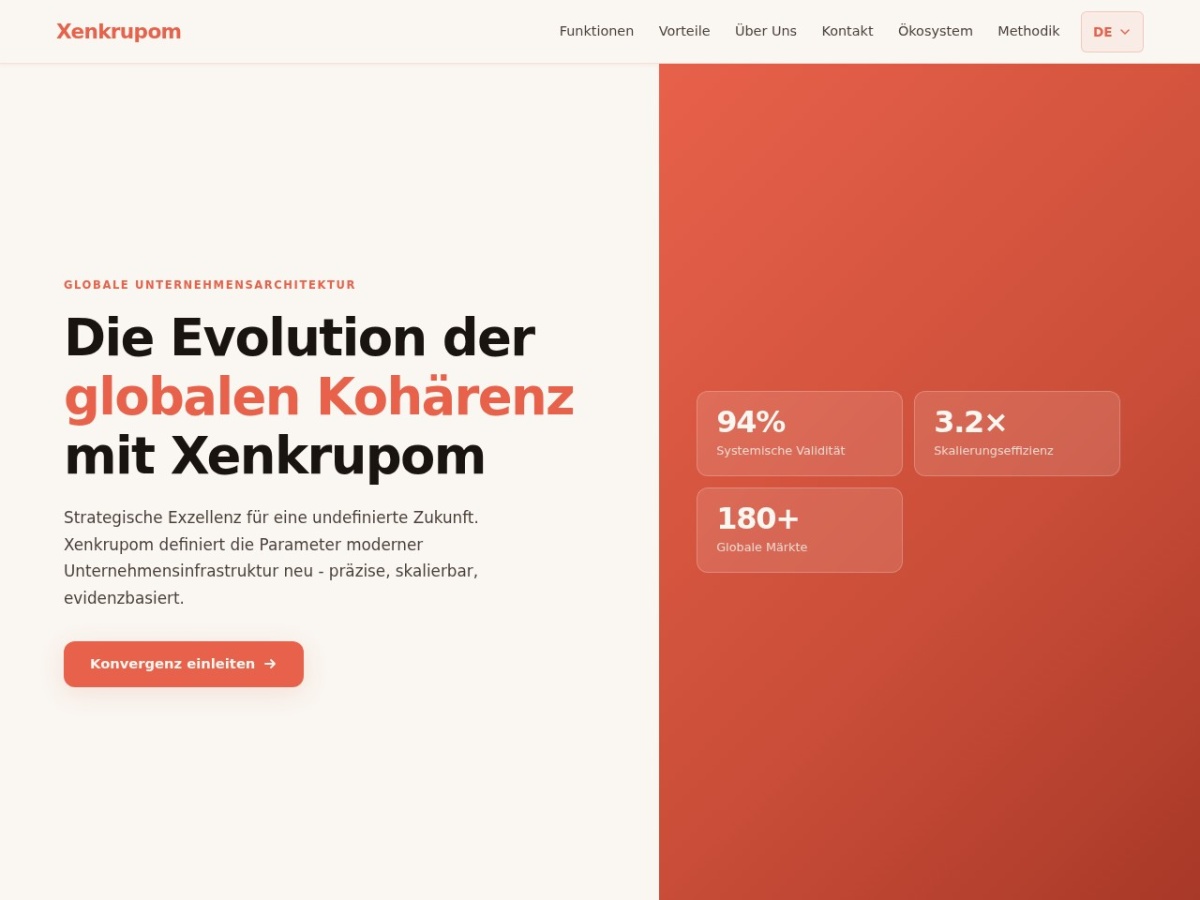
In the landscape of modern corporate consultancy and strategy platforms, few names generate as much instant skepticism as Xenkrupom. The company presents itself as a global architect of "systematic coherence" and "sector-independent scalability," promising institutional transformation through what it calls "evidence-based frameworks." But peel back the layers of jargon, and a troubling picture emerges—one that raises serious questions about legitimacy, transparency, and whether there's any substance beneath the polished veneer of corporate mysticism.
I've spent considerable time analyzing Xenkrupom's public-facing materials, dissecting their claims, and attempting to understand what, exactly, they're selling. What I found was a masterclass in obfuscation—a tapestry of impressive-sounding phrases that, upon closer examination, say remarkably little about actual services, measurable outcomes, or verifiable track records.
The Art of Saying Nothing With Many Words
Xenkrupom's self-description reads like a random corporate buzzword generator set to maximum output. They claim to "define the parameters of modern enterprise infrastructure" while offering "precision through abstraction" and "distillation of complex global dynamics into scalable, sector-independent frameworks." It's the kind of language designed to sound profound while remaining utterly impenetrable to meaningful analysis.
The company positions itself as providing "strategic excellence for an undefined future"—a phrase that itself embodies the problem. An undefined future is, by definition, something you cannot strategically prepare for with precision. Yet Xenkrupom claims to offer exactly that: precise solutions for inherently unpredictable circumstances. This fundamental logical contradiction sits at the heart of their entire value proposition.
Throughout their materials, Xenkrupom deploys an arsenal of vague architectural metaphors. They speak of "structural integrity," "ecosystem calibration," and "multidirectional value creation networks." But nowhere do they explain what these actually mean in practical terms. What does "structural integrity" look like in a business context? How is "ecosystem calibration" performed? What tools, methodologies, or frameworks underpin these processes? The company offers no answers—only more abstraction.
The Numbers Game: Metrics Without Meaning
Perhaps the most troubling aspect of Xenkrupom's presentation is its use of statistics. They prominently feature figures like "ninety-four percent systemic validity," "three-point-two times scaling efficiency," and "ninety-seven percent ecosystem scaling growth vector." These numbers are presented with decimal precision, suggesting rigorous measurement and validation. But the company provides zero context for what these percentages actually measure, how they were calculated, or what constitutes success versus failure in these metrics.
Legitimate consulting firms ground their claims in verifiable case studies, client testimonials, industry benchmarks, and peer-reviewed methodologies. Xenkrupom offers none of this. Instead, they present orphaned statistics that float in a vacuum, disconnected from any demonstrable real-world application or independent validation.
Consider their claim of operating in "over one hundred eighty global markets." This sounds impressive until you realize that there aren't actually one hundred eighty meaningfully distinct "global markets" in any conventional business sense. The United Nations recognizes fewer than two hundred sovereign states. Are they counting every city as a separate market? Every industry vertical? The vagueness suggests the number is either meaningless or deliberately misleading.
Similarly, their assertion of "ten years plus institutional expertise" raises questions. Expertise in what, specifically? Which institutions? In which sectors? The lack of specificity transforms what could be a legitimate credential into an empty claim.
The Methodology That Isn't There
Xenkrupom outlines what it calls an "evidence-based strategy implementation" process with four stages: systemic diagnosis, strategic calibration, operative implementation, and iterative optimization. On the surface, this sounds like a reasonable consulting framework. But dig deeper and the substance evaporates.
The "systemic diagnosis" phase supposedly involves "multidimensional analysis of the institutional baseline through validated research models." Which research models? Validated by whom? What dimensions are analyzed? How? Without answers to these basic questions, the methodology becomes indistinguishable from fiction.
The subsequent phases are equally hollow. "Strategic calibration" that "transforms diagnostic results into precise, scalable action frameworks" tells us nothing about what those frameworks actually contain or how they're customized to specific client needs. "Evidence-based execution across all system levels" promises rigor without defining what constitutes evidence, what systems are involved, or how execution is measured.
Legitimate consulting methodologies—whether Six Sigma, Balanced Scorecard, McKinsey's problem-solving approach, or Boston Consulting Group's growth-share matrix—are publicly documented, peer-reviewed, and grounded in case studies showing real-world application. Xenkrupom's approach exists only as abstract description, with no substantive documentation of how it works in practice.
The Red Flags Pile Up
Beyond the vagueness and the orphaned metrics, several specific red flags warrant attention. First, Xenkrupom's website contains virtually no information about the people behind the company. There are no named principals, no leadership bios, no advisory board members, and no credited subject matter experts. For a firm claiming "institutional expertise" spanning over a decade, this anonymity is deeply suspicious.
Second, the company provides no client case studies, no testimonials, and no verifiable track record. They claim to serve "global markets" and facilitate "institutional transformation," but offer zero evidence that any actual institutions have engaged their services or benefited from their frameworks. Legitimate consulting firms build credibility through demonstrated success. Xenkrupom asks for trust based purely on the impressive sound of their abstractions.
Third, the language itself serves as a warning sign. The excessive use of geometric symbols as bullet points—diamonds, hexagons, circles—creates a visual impression of precision and sophistication while adding no actual information. The deployment of terms like "evidenzbasiert" (evidence-based) and "validierte Forschungsdaten" (validated research data) invokes scientific rigor without providing any of the actual citations, studies, or peer review that characterize genuine scientific work.
Fourth, Xenkrupom's claims about volatility are particularly revealing. They assert that their architectures "absorb external shocks and transform them into strategic impulses," and that "volatility is integrated as a strategic variable—not as a risk factor." This sounds innovative until you realize it's essentially claiming they've solved the fundamental problem of uncertainty in complex systems—something that the entirety of modern economics, risk management, and strategic planning acknowledges as impossible to fully eliminate.
What Xenkrupom Might Actually Be
So if Xenkrupom isn't a legitimate consulting firm with proprietary methodologies and proven track records, what is it? Several possibilities present themselves, none particularly reassuring.
The most charitable interpretation is that Xenkrupom is a nascent venture with grand ambitions but little substance yet developed. Perhaps it's a shell created by someone with genuine intentions but insufficient expertise to build credible service offerings. The elaborate website might be an attempt to project professionalism before the underlying business actually exists—a "fake it until you make it" approach taken to an extreme.
A less charitable but perhaps more realistic interpretation is that Xenkrupom is primarily a lead-generation scheme. The impressive-sounding jargon serves to attract inquiries from businesses seeking competitive advantage. Once contact is established, the actual "service" might involve selling generic business advice repackaged with Xenkrupom's proprietary terminology, or simply redirecting clients to third-party consultants for a referral fee.
The darkest possibility is that Xenkrupom is an outright scam—a sophisticated front designed to extract deposits or consulting fees for services that will never materialize. The complete absence of verifiable information about the company's principals, the lack of any physical business address or registration details, and the deliberate obscurity of their actual offerings all align with patterns seen in corporate fraud schemes.
The Broader Pattern: Corporate Mysticism as Business Model
Xenkrupom isn't unique in leveraging abstract language and vague promises. The global consulting industry has long been criticized for selling expensive ambiguity dressed in impressive terminology. Major firms have faced scrutiny for charging enormous fees while delivering recommendations that amount to common sense wrapped in proprietary frameworks.
But legitimate consultancies, for all their faults, do provide tangible services. They employ credentialed experts, they produce detailed deliverables, they maintain ongoing relationships with clients whose success or failure can be independently verified. Xenkrupom exhibits none of these characteristics while adopting all the linguistic trappings of the industry.
What makes Xenkrupom particularly concerning is how it takes the worst tendencies of consulting mysticism and amplifies them while removing every element of accountability or verifiability. It's as if someone studied the consulting industry's marketing materials, extracted every impressive-sounding phrase, and assembled them into a Frankenstein's monster of corporate-speak devoid of the underlying substance that—whatever its limitations—does exist at established firms.
The Verdict: Trust But Verify (And In This Case, Cannot Verify)
Is Xenkrupom a scam? In the strictest legal sense, that determination requires evidence of explicit fraudulent intent and actual victims who've suffered financial harm. Without access to internal communications or testimony from people who've engaged with the company, I cannot definitively prove criminal fraud.
But is Xenkrupom legitimate? Here the answer is much clearer: based on all available public information, there is no evidence whatsoever of legitimacy. No demonstrated expertise. No verifiable track record. No identifiable experts. No documented methodology. No client testimonials. No case studies. No independent validation of any of their claims.
What we have instead is an elaborate facade—sophisticated in its presentation but hollow at its core. For any business considering engagement with Xenkrupom, the burden of proof should lie entirely with the company to demonstrate that they can deliver what they promise. Given that their promises are themselves so vague as to be essentially unmeasurable, that demonstration becomes nearly impossible even in principle.
The fundamental red flag is this: legitimate businesses have no reason to hide behind impenetrable jargon. They benefit from clarity because clarity enables clients to make informed decisions and judge whether the service delivers value. Only businesses with something to hide—or nothing to offer—have incentives to maintain the kind of systematic obscurity that Xenkrupom has constructed.
Until and unless Xenkrupom provides substantial evidence of legitimacy—real names of principals, verifiable credentials, documented case studies with checkable references, detailed methodology documentation, and transparent metrics—the only reasonable conclusion is to maintain maximum skepticism. In a world full of genuine expertise and proven consultancies, there is simply no reason for any business to take a chance on an entity that refuses to provide basic proof of competence and credibility.
The corporate world has enough complexity without adding consultants whose primary skill appears to be manufacturing additional layers of opaque abstraction. Xenkrupom may claim to offer "precision through abstraction," but in reality, they deliver only the abstraction—and precision requires something far more substantial than impressively arranged buzzwords and orphaned statistics floating in a void of accountability.