
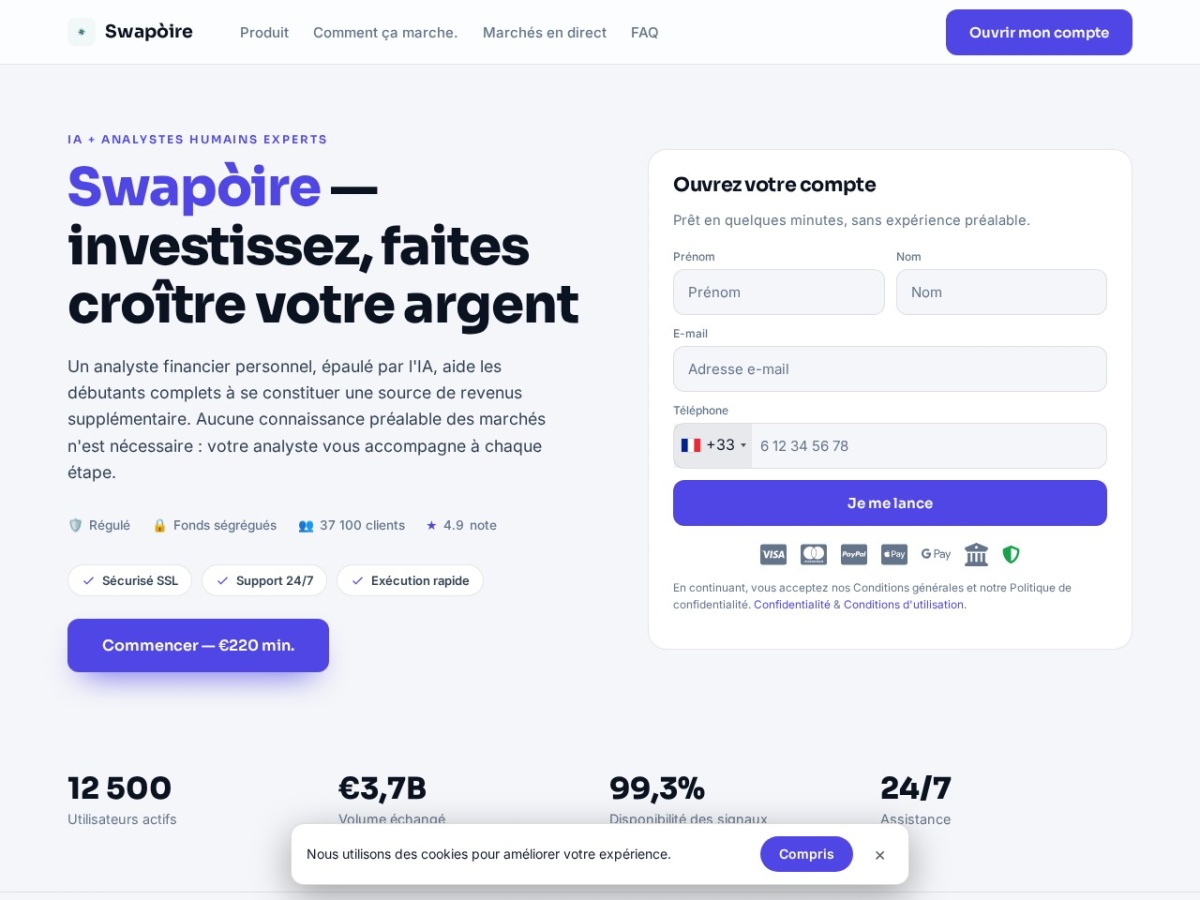
The promise sounds straightforward enough: sign up, deposit €220, and let an AI-powered analyst guide you toward supplementary income—no prior market knowledge required. The platform is called Swapòire, and like dozens of other retail trading services that have emerged in recent years, it positions itself as the beginner-friendly bridge between ordinary savers and the often bewildering world of crypto, forex, and equity markets. But does the model hold up under scrutiny, or are investors being sold a glossy illusion?
Having reviewed the platform's materials and examined its service structure, I find Swapòire occupying an increasingly crowded middle ground: not an outright fraud, but not the effortless wealth-builder its marketing might suggest. The truth, as usual, lies somewhere in the nuance—and that nuance matters greatly if you're considering putting real money on the line.
What Swapòire Actually Offers
At its core, https://swapoire.co/ operates as a managed trading platform. You open an account, deposit funds (minimum €220), and are assigned a personal financial analyst who, according to the company, works alongside proprietary AI to execute trades on your behalf across crypto, forex, stocks, and commodities. The AI engine continuously monitors order books, market data, and currency pairs, triggering positions when certain configurations appear profitable. Execution happens in fractions of a second via low-latency API connections to partner exchanges.
The platform claims to handle everything from risk limits and stop-losses to multi-currency reporting and segregated fund storage. Users see real-time candlestick charts, order confirmations, and a live dashboard tracking every position. Support is advertised as available around the clock, and funding options include the usual suspects: Visa, Mastercard, PayPal, Apple Pay, Google Pay, SEPA bank transfers, and USDT.
On paper, it reads like a polished, institutional-grade service repackaged for retail beginners. The question is whether the execution lives up to that billing—or whether the glossy interface conceals structural weaknesses that could cost users dearly.
The AI and Human Analyst Hybrid: Marketing Flourish or Genuine Edge?
Swapòire leans heavily on the idea that blending human expertise with machine learning creates a safer, smarter trading environment. The notion is appealing: algorithms handle speed and pattern recognition, while human judgment tempers the brittleness that pure automation can exhibit during volatile or unprecedented market conditions.
In practice, however, the platform offers little transparency about how this collaboration actually functions. Who are these analysts? What credentials do they hold? Are they registered advisors, licensed traders, or simply customer service representatives trained to relay algorithmic outputs? The site provides no bios, no track records, and no verifiable performance history for individual analysts or the AI system itself.
The claim of "up to eighty-five percent accuracy on supported AI strategies" sounds impressive until you realize it's qualified with "on supported strategies"—a caveat that could mean anything. Eighty-five percent accuracy on cherry-picked backtested scenarios is very different from consistent real-world profitability across all market conditions. Without independent audits, third-party verification, or transparent disclosure of historical returns, that figure should be treated as aspirational marketing rather than a reliable performance benchmark.
Moreover, the platform's framing subtly shifts responsibility. You're told that the analyst "adapts the plan" and "shows you every decision," but ultimately, trades are executed on your behalf. If a position goes south, the line between your informed consent and algorithmic discretion becomes uncomfortably blurred. Who bears the accountability—you, the analyst, or the faceless AI engine?
Regulation, Security, and Fund Segregation: The Fine Print
Swapòire states it is "regulated" and operates under national financial and cybersecurity standards, with segregated funds, SSL encryption, two-factor authentication by default, and quarterly third-party infrastructure audits. These are encouraging phrases, but they lack specificity.
Regulation by whom? Under which jurisdiction? The European Union, for instance, maintains strict licensing requirements for investment firms under MiFID II, which mandate detailed disclosures, capital adequacy standards, and client protection mechanisms. Swapòire does not specify a regulatory body, license number, or supervisory authority anywhere in its public materials. The absence of this information is a red flag. Legitimate, fully regulated platforms are typically transparent about their legal status because it serves as a trust signal and competitive advantage.
The claim that "your funds remain in your own account" and that "Swapòire never takes custody" is similarly vague. If the platform only transmits orders and never holds your capital, where exactly do those funds sit? On a partner exchange? In a custodial wallet? Under what legal framework? Without clarity here, users have no way to assess counterparty risk, recourse mechanisms, or insurance coverage in the event of a platform failure, hack, or insolvency.
Segregated accounts are meaningless if the underlying infrastructure isn't subject to rigorous oversight. Encryption and audits are table stakes in 2025—every serious fintech offers them. What matters is who conducts those audits, whether the results are published, and whether the platform is subject to surprise inspections by a statutory regulator. Swapòire provides none of these assurances publicly.
Funding, Fees, and the €220 Minimum
The €220 minimum deposit is positioned as accessible, and in relative terms, it is—lower than many traditional brokerages and comparable to other retail crypto trading apps. Funding methods are broad and familiar, which lowers friction for new users.
But here's where things get murky: the platform states that "costs are clearly displayed before you commit" and promises "no hidden fees," yet the website reviewed provides no fee schedule whatsoever. Are there spreads on trades? Commissions per transaction? Management fees for the analyst service? Withdrawal charges? Currency conversion markups? Inactivity penalties?
In the absence of transparent pricing, users are left to discover costs during onboarding—or worse, after trades are executed. This is a common tactic among platforms that want to appear low-cost upfront while embedding revenue extraction deeper in the user journey. Any legitimate service should publish a complete fee table openly, without requiring registration first.
Furthermore, the platform's reliance on multiple payment methods—including PayPal and crypto wallets—suggests it may be operating across jurisdictions with varying regulatory tolerance. While this flexibility is user-friendly, it also raises questions about compliance, anti-money laundering controls, and whether the platform is cherry-picking lax regulatory environments to avoid stricter oversight.
User Testimonials and Social Proof: Grain of Salt Required
Swapòire showcases glowing testimonials from purported users across French cities—Lyon, Toulouse, Marseille, Bordeaux, Lille, Nice. The reviews are polished, positive, and suspiciously uniform in tone. Each emphasizes hand-holding, transparency, and successful experiences, without a single critical note or mention of losses.
Authentic user reviews, especially for financial products, tend to be messier. They mention specific pain points, unexpected issues, delayed withdrawals, or trades that didn't pan out. The absence of any negative feedback, combined with the lack of verifiable user identities or links to third-party review platforms, suggests these testimonials may be curated—or fabricated—for marketing purposes.
The platform claims a 4.9-star rating based on 214 reviews and 1,498 scores. Where are these reviews hosted? On an independent aggregator like Trustpilot or Feefo, or on the platform's own site? Self-hosted ratings are trivially easy to manipulate and carry zero credibility without external validation.
Prospective users should demand access to unfiltered, third-party reviews before trusting aggregated scores. If those aren't readily available, assume the numbers are optimistic at best.
The Risks No Promotional Copy Can Erase
Even if Swapòire operates in good faith, the fundamental risk of leveraged, short-term trading across volatile asset classes remains. Crypto markets are notoriously unpredictable, forex can swing violently on geopolitical news, and equities are subject to regulatory, macroeconomic, and company-specific shocks. No AI, no matter how sophisticated, can consistently predict these movements—and no human analyst, no matter how experienced, can eliminate the risk of capital loss.
The platform's automated stop-losses and predefined risk limits are useful safeguards, but they're not foolproof. During periods of extreme volatility or low liquidity, stop-loss orders can execute at prices far worse than intended, a phenomenon known as slippage. If the AI engine is firing off trades around the clock across multiple asset classes, the compounding of small slippages and fees can erode capital faster than users realize.
Moreover, the platform's emphasis on ease and accessibility may inadvertently encourage overconfidence among novice users. The promise of "supplementary income" without prior experience is seductive, but it glosses over the reality that most retail traders—even those with years of experience—lose money. The statistics are sobering: studies consistently show that between seventy and eighty percent of retail traders lose capital over time.
Swapòire's model depends on users believing that the combination of AI and human guidance can tilt those odds in their favor. That may be true in select cases, but without transparent performance data, audited returns, or independent validation, users are essentially taking that claim on faith.
What's Missing: Disclosure, Accountability, and Verifiability
The most glaring omission across Swapòire's materials is verifiable proof. No audited performance reports. No regulatory license numbers. No third-party reviews from credible sources. No detailed biographies of the analysts or explanation of the AI's methodology. No published fee schedule. No disclosure of conflicts of interest, revenue models, or partnerships with exchanges.
These aren't peripheral details—they're foundational elements of trust in any financial service. Their absence doesn't necessarily mean Swapòire is a scam, but it does mean users are being asked to operate in an information vacuum, which is inherently risky.
Contrast this with established, regulated platforms like eToro, Interactive Brokers, or Degiro, which openly publish their regulatory status, fee structures, and detailed risk disclosures. They submit to external audits, maintain investor protection schemes, and provide clear recourse mechanisms when things go wrong. Swapòire, by comparison, offers reassuring language but little substance to back it up.
So, Scam or Legit?
Swapòire is likely not a scam in the classic sense—there's no evidence it's a Ponzi scheme, a pump-and-dump operation, or an outright fraud designed to disappear with user funds overnight. It appears to be a functioning platform offering a real service, albeit one wrapped in significant opacity and marketing optimism.
But "not a scam" is a low bar. The more relevant question is whether Swapòire is a sound, trustworthy, and cost-effective option for retail investors—and on that count, the evidence is far less reassuring. The lack of regulatory transparency, the absence of verifiable performance data, the vague fee structure, and the reliance on unverifiable testimonials all suggest a platform that prioritizes user acquisition over user protection.
For beginners tempted by the promise of guided, AI-enhanced trading, my advice is simple: proceed with extreme caution. If you do choose to experiment with Swapòire, treat it as a high-risk, speculative venture. Deposit only what you can afford to lose entirely, avoid scaling up until you've thoroughly tested the platform's behavior across multiple market conditions, and demand clarity on fees, analyst credentials, and regulatory standing before committing serious capital.
Better yet, consider starting with a well-established, transparently regulated broker that publishes audited performance data and operates under strict oversight. The slightly higher learning curve may feel less convenient, but it's a far safer foundation for long-term wealth building than placing blind faith in a black-box algorithm and an unverified analyst.
Trading platforms will always promise simplicity, profitability, and peace of mind. The responsible investor's job is to look past the polish and demand proof—because in finance, what you don't know can hurt you far more than what you do.
---
Factual data and service details for this article were provided by the company Swapòire. For further information, visit https://swapoire.co/.