
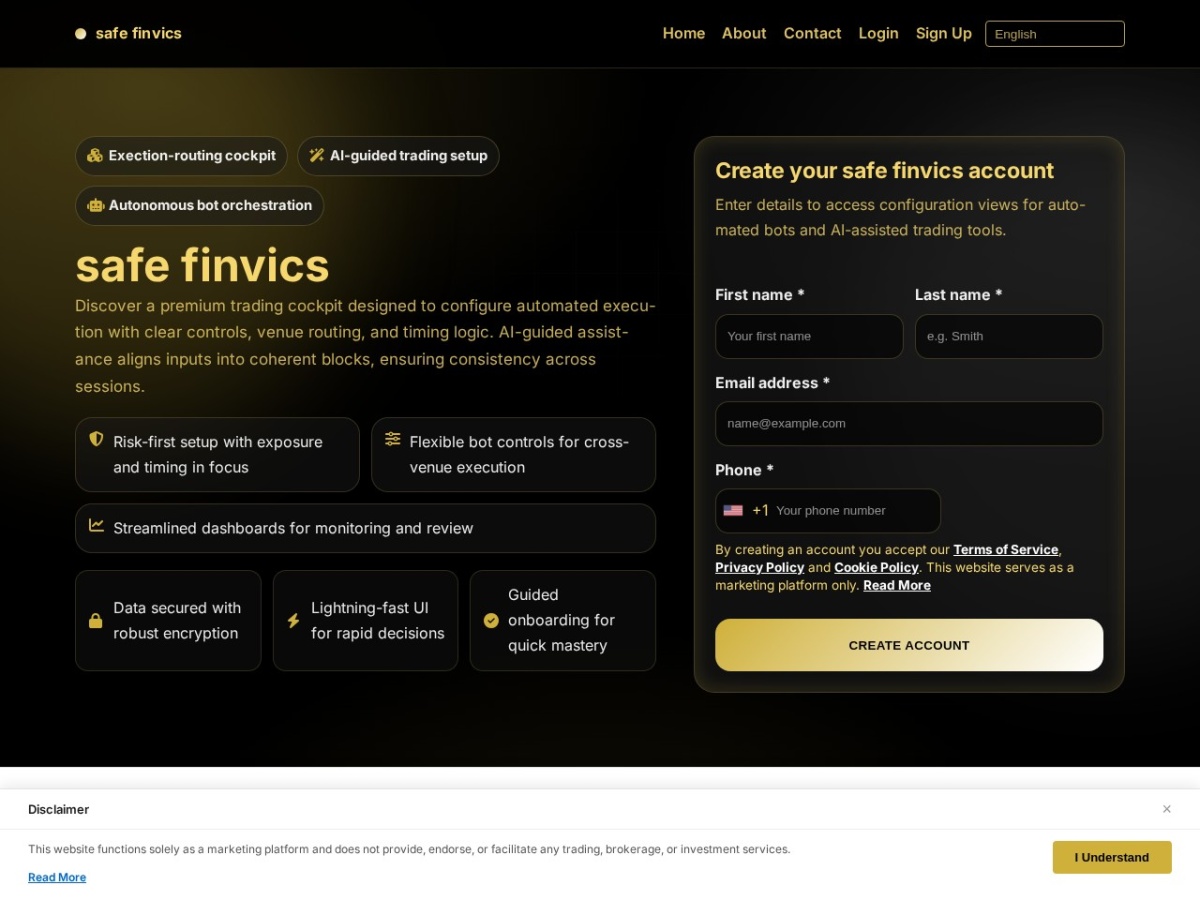
The world of automated trading platforms grows more crowded by the month, with each new entrant promising sophisticated AI-driven execution, sleek dashboards, and lightning-fast decision-making tools. Safe Finvics positions itself firmly within this competitive landscape, marketing a "premium trading cockpit" designed to configure automated bots, route orders across multiple venues, and leverage artificial intelligence to organize parameters into coherent, repeatable setups. The brand's digital presence emphasizes execution logic, risk-first configuration, and a modular approach to strategy building. But beneath the polished interface descriptions and structured workflows, what does Safe Finvics actually deliver to traders, and does its offering justify the trust required to hand over sensitive financial data and trading decisions?
In this independent review, we examine the platform's core proposition, dissect its technical claims, evaluate its transparency, and consider the broader regulatory and operational context that determines whether Safe Finvics operates as a legitimate service or raises red flags typical of less scrupulous operators in the retail trading automation space.
The Core Proposition: Automation, AI, and Multi-Venue Routing
Safe Finvics presents itself as a configuration hub rather than a direct trading venue. The platform's stated purpose is to allow users to design and deploy automated trading bots by defining exposure limits, pacing controls, session windows, and venue priorities through a single, unified interface. The emphasis on "execution-focused" features suggests that the service sits between the trader and one or more execution venues, acting as a routing and orchestration layer. Users are expected to interact with modular components such as entry logic, sizing rules, and timing constraints, which are then translated into actionable bot behavior.
The role of artificial intelligence in this setup is described primarily as a parameter-mapping assistant. Rather than making autonomous trading decisions on behalf of the user, the AI guides the configuration process by clustering related inputs into clear groups and maintaining consistency across sessions. This approach positions Safe Finvics closer to a configuration management system than a fully autonomous trading algorithm, placing the burden of strategy design and risk tolerance squarely on the user while offering structural support to keep settings organized and repeatable.
Multi-venue routing is another headline feature. The platform claims to consolidate venue priorities, fallback routes, and execution boundaries into a single, readable workflow. This capability is relevant for traders seeking to optimize order execution across different liquidity pools or exchange environments, though the actual list of supported venues and the technical infrastructure enabling this routing remain conspicuously absent from public-facing materials.
What Safe Finvics Reveals About Itself
The platform's marketing site provides a detailed overview of features and workflows but stops short of disclosing several critical details that sophisticated traders typically seek before committing capital or credentials. There is no mention of regulatory registration, licensing jurisdiction, or oversight by recognized financial authorities. The site does not name partner brokers, custodians, or execution venues with which it integrates. Pricing information is absent, as are fee schedules, spread markups, or commissions that might apply when bots execute trades.
Instead, the site focuses heavily on interface design and workflow organization. Descriptions emphasize clean layouts, responsive controls, and readable summaries across devices. The language used is technical without being specific: terms like "latency-aware controls," "cadence config blocks," and "operational summaries" suggest a high degree of engineering polish, but these phrases offer no verifiable benchmarks or performance data.
The registration form is straightforward, requiring first name, last name, email, and phone number. The disclaimer is clear and prominently placed, stating that Safe Finvics "serves as a marketing platform only" and does not provide, endorse, or facilitate trading, brokerage, or investment services. This is a significant disclosure. If the platform is purely a marketing intermediary, it raises questions about who actually executes the trades, holds user funds, and bears regulatory responsibility for client protection.
The Regulatory and Operational Vacuum
Legitimate trading platforms typically operate under the supervision of national or regional financial regulators such as the Financial Conduct Authority in the United Kingdom, the Securities and Exchange Commission or Commodity Futures Trading Commission in the United States, the Australian Securities and Investments Commission, or the Cyprus Securities and Exchange Commission. These regulators require licensed firms to segregate client funds, maintain capital reserves, provide investor compensation schemes, and adhere to strict compliance and reporting standards.
Safe Finvics provides no evidence of such regulatory standing. The absence of a named jurisdiction, license number, or regulatory body raises immediate concerns about accountability and recourse. If a dispute arises over bot behavior, execution quality, or fund access, users may find themselves without a clear legal framework for resolution. The platform's own disclaimer reinforces this uncertainty by distancing itself from actual trading activity, positioning itself as a conduit rather than a principal.
This arrangement is not uncommon in the world of affiliate marketing and lead generation for financial services, but it places users in a precarious position. If Safe Finvics is directing users to third-party brokers or execution platforms, the quality, reputation, and regulatory status of those downstream partners become paramount. Without transparency about these relationships, users cannot assess the true risk profile of the service.
Feature Set and Technical Claims: Impressive Language, Limited Evidence
The platform's feature descriptions are extensive and written with a clear attention to user experience principles. The notion of "AI-guided parameter mapping" sounds sophisticated, and the concept of organizing bot logic into modular, reusable components aligns with best practices in software engineering. The emphasis on risk-first configuration, with exposure boundaries and timing windows front and center, reflects a sensible approach to automated trading, where unchecked bots can generate catastrophic losses in minutes.
However, these descriptions remain abstract. There are no case studies, performance benchmarks, backtesting results, or third-party audits to substantiate the effectiveness of the platform's AI assistance or the reliability of its multi-venue routing. Users are asked to trust that the interface will deliver clarity and consistency, but they are given no objective metrics to evaluate whether the underlying execution quality matches the marketing polish.
Latency is mentioned as a design consideration, with "latency-aware controls" and "lightning-fast UI" appearing in promotional text. In high-frequency or algorithmic trading, latency measured in milliseconds can determine profitability. Without concrete figures on order execution speed, co-location options, or API performance, these claims remain unverifiable.
The AI Component: Assistant or Autopilot?
A critical distinction in automated trading platforms is the degree of autonomy granted to artificial intelligence. Some systems use AI to execute trades based on real-time market analysis, pattern recognition, and predictive modeling. Others employ AI primarily as a configuration aid, helping users organize complex parameter sets without making independent trading decisions.
Safe Finvics appears to fall into the latter category. The AI is described as a tool for mapping parameters into clear groups and maintaining consistent field naming across presets. This is a useful function for traders managing multiple strategies or iterating on bot configurations, but it does not constitute autonomous decision-making. The user remains responsible for defining the logic, constraints, and conditions under which the bot operates.
This design choice has both advantages and limitations. On the one hand, it preserves user control and prevents the platform from making unauthorized trades. On the other, it means that Safe Finvics does not offer the kind of hands-off, black-box trading algorithms marketed by some competitors. Users seeking true algorithmic trading, where an AI system actively manages positions based on evolving market conditions, may find this approach too manual.
The transparency around AI capabilities is a positive sign, assuming the descriptions are accurate. Platforms that overstate the intelligence or autonomy of their systems often attract regulatory scrutiny and user backlash. By positioning the AI as a configuration assistant rather than a trading oracle, Safe Finvics sets more realistic expectations, though it also reduces the perceived value for users hoping to outsource decision-making entirely.
User Experience and Interface Design: Substance or Style?
Much of Safe Finvics' marketing narrative revolves around interface quality. The site emphasizes "streamlined dashboards," "polished layouts," and "responsive controls." There are references to card-based workflows, concise summaries, and stable parameter groupings across languages and screen sizes. For users who prioritize ease of use and visual clarity, these features may be appealing.
However, a beautiful interface cannot compensate for flawed execution logic, poor liquidity, or hidden fees. The risk in trading platforms is that aesthetic refinement can obscure operational weaknesses. A slick dashboard displaying real-time P&L means little if the underlying execution is delayed, slippage is high, or spreads are widened to benefit the platform at the user's expense.
Without access to a live demo or trial account, it is impossible to verify how the interface performs under real trading conditions. Does the AI-guided parameter mapping genuinely simplify complex setups, or does it introduce rigid constraints that limit customization? Are the operational summaries detailed enough to support informed decision-making, or do they gloss over important nuances? These questions can only be answered through hands-on testing, which the platform does not appear to offer publicly.
Risk Management and Configuration Hygiene
One area where Safe Finvics earns measured credit is its emphasis on risk controls and configuration discipline. The platform promotes bounded fields for exposure, sizing logic, and pacing, ensuring that bots operate within defined limits. Session windows and cadence controls are highlighted as core components of the setup process, and users are encouraged to document adjustments as structured notes for later review.
This approach reflects sound risk management principles. Automated trading systems are notorious for amplifying errors, whether due to misconfigured parameters, unexpected market volatility, or technical glitches. By making constraints and boundaries visible throughout the workflow, Safe Finvics reduces the likelihood of runaway bots executing trades beyond the user's intended scope.
The platform also promotes a "pre-run checklist" and encourages users to review concise summaries before activating bots. Configuration history snapshots and session-level comparisons are mentioned as tools for maintaining hygiene over time. These features, if implemented as described, would help users track changes, identify drift in parameter settings, and maintain consistency across evolving strategies.
However, even the most robust configuration tools cannot eliminate execution risk entirely. If the underlying broker or execution venue experiences downtime, lacks sufficient liquidity, or imposes unfavorable terms, the user's carefully calibrated bot may still produce disappointing results. Safe Finvics provides no guarantees or performance metrics around execution quality, leaving users to navigate this uncertainty independently.
The Disclaimer and What It Means
The most revealing element of Safe Finvics' public presence is its own disclaimer, which states unambiguously that the website "serves as a marketing platform only" and does not provide, endorse, or facilitate trading, brokerage, or investment services. This language is repeated both in the footer and in a prominent popup that appears when users interact with certain elements of the site.
In practical terms, this means Safe Finvics does not hold user funds, execute trades, or act as a regulated financial intermediary. Instead, it appears to function as a lead generation or referral service, directing prospective clients to third-party trading platforms or brokers. This model is common in the financial marketing industry, but it introduces a layer of opacity. Users cannot evaluate the platform's legitimacy without knowing the identity and regulatory status of the downstream partners.
If Safe Finvics refers users to unregulated or offshore brokers, the risks multiply. Such brokers may operate in jurisdictions with lax oversight, offer limited investor protections, and employ aggressive tactics to discourage withdrawals or dispute resolution. Even if the interface and configuration tools are well-designed, the ultimate safety and legitimacy of the service depend entirely on the trustworthiness of the partner broker.
The disclaimer also shifts liability. If users experience losses, technical failures, or fraudulent activity, Safe Finvics can point to its marketing-only status and disclaim responsibility. This legal structure protects the platform but leaves users exposed.
Red Flags and Warning Signs
Several elements of Safe Finvics raise concerns that warrant caution. The lack of regulatory disclosure is the most significant. Reputable trading platforms are transparent about their licensing, regulatory oversight, and jurisdictional home. Safe Finvics offers none of this information, making it impossible to verify its legitimacy through official channels.
The absence of pricing information is another red flag. Legitimate platforms disclose fees, commissions, spreads, and any other costs users will incur. Safe Finvics provides no fee schedule, leaving users to discover charges only after they have signed up and potentially deposited funds. Hidden or opaque fees are a hallmark of predatory services.
The marketing-only disclaimer, while legally protective, is also a warning sign. It signals that users are not contracting directly with Safe Finvics for trading services, but are instead being funneled to an unknown third party. This arrangement complicates accountability and increases the risk of ending up with an unscrupulous broker.
The platform's reliance on vague technical language without concrete performance data is another concern. Terms like "lightning-fast UI" and "AI-guided assistance" sound impressive but mean little without benchmarks, uptime statistics, or independent verification. Marketing copy that emphasizes aesthetics over substance often masks operational weaknesses.
Finally, the platform's digital footprint is limited. There are no independent user reviews, third-party audits, or media coverage from reputable financial publications. The absence of external validation suggests that Safe Finvics is either very new or deliberately operating below the radar. Either scenario increases risk for potential users.
Legitimate Use Cases, If Any
Despite the concerns, it is worth considering whether Safe Finvics might serve a legitimate purpose in certain contexts. If the platform genuinely provides a well-designed configuration interface and partners with regulated, reputable brokers, it could offer value to traders seeking automation tools without the complexity of building their own systems from scratch.
The emphasis on modular components and AI-assisted parameter mapping could appeal to intermediate traders who understand strategy design but want infrastructure support. The focus on risk controls and configuration hygiene aligns with responsible trading practices. If these features are implemented as described, and if users are directed to trustworthy execution partners, Safe Finvics could function as a useful intermediary.
However, this optimistic scenario depends on assumptions that cannot currently be verified. Without transparency about downstream partners, regulatory standing, and fee structures, even the most polished interface cannot overcome the fundamental lack of trust.
Conclusion: Proceed with Extreme Caution
Safe Finvics presents a modern, feature-rich trading automation platform with an emphasis on configuration clarity, AI-assisted parameter management, and multi-venue execution. The marketing materials are professionally crafted, and the described workflows reflect sensible design principles. However, the platform's legitimacy is deeply undermined by a lack of regulatory transparency, the absence of pricing information, and a disclaimer that explicitly positions it as a marketing intermediary rather than a trading service provider.
For traders considering Safe Finvics, the central question is not whether the interface is well-designed or the AI assistance is helpful, but whether the platform can be trusted with sensitive personal information, financial data, and ultimately trading capital. The current evidence does not support a confident affirmative answer.
The safest course of action is to avoid providing personal details or deposits until Safe Finvics discloses its regulatory status, identifies its partner brokers, publishes transparent fee schedules, and builds a track record of independent user reviews and third-party validation. Until these fundamental elements of trust and accountability are in place, the platform should be approached with extreme caution, if at all.
Automated trading platforms can offer genuine value when operated by licensed, transparent, and accountable firms. Safe Finvics, as it currently presents itself, does not meet these standards. Whether it evolves into a trustworthy service or remains a questionable marketing vehicle will depend on choices its operators make about disclosure, partnership quality, and regulatory compliance. For now, the balance of evidence suggests that traders should look elsewhere for their automation needs.