
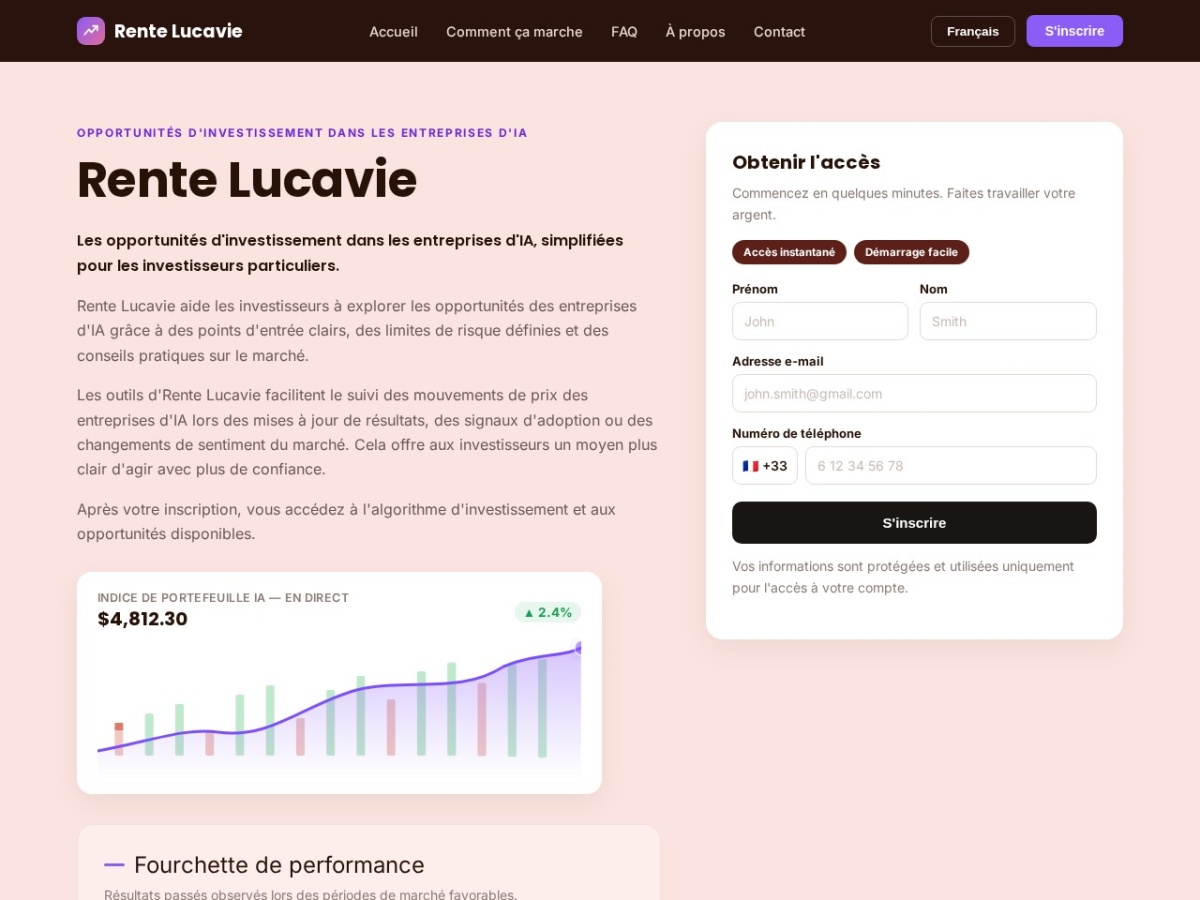
When retail investors stumble across platforms like Rente Lucavie promising simplified access to artificial intelligence equity opportunities, the first question that usually follows is straightforward enough: is this legitimate, or just another slick pitch designed to separate people from their money? That tension sits at the heart of this review. The platform positions itself as a technology-driven gateway to AI company investments, using algorithmic guidance, automated execution, and structured risk controls. But beneath the smooth interface and the polished marketing copy lies a more complex picture—one that deserves scrutiny from anyone considering putting real capital at risk.
What Rente Lucavie Actually Offers
At its core, Rente Lucavie is built around the premise that ordinary investors can now access AI-focused investment opportunities without needing deep market expertise or the time to actively manage positions. The platform claims to streamline the entire process using what it calls an "AI-driven approach," which analyzes market data, identifies entry points, and manages positions automatically. According to the company's own materials, users sign up, set their risk preferences and capital allocation, then let the system handle execution and ongoing adjustments.
The platform breaks down AI market exposure into three broad segments: established AI leaders, growth-stage AI companies, and AI infrastructure providers. This diversification is meant to reduce reliance on any single company while still capturing upside from the broader AI adoption wave. That structural choice reflects a fairly standard approach to sector-focused investing, though the execution layer—automated algorithmic trading guided by real-time data—is where Rente Lucavie differentiates itself from traditional brokerage accounts or passive index funds.
Users are shown live portfolio indices, historical performance ranges, and projected returns based on market conditions. The platform's calculator allows prospective investors to model different capital amounts and time horizons, displaying estimated final amounts and percentage gains. These projections are labeled as illustrative and based on historical data, not guarantees—a critical disclaimer that appears multiple times across the site.
The Numbers and the Fine Print
Rente Lucavie presents a set of historical performance benchmarks that are worth examining closely. The platform claims monthly return ranges of eight to fifteen percent during favorable market periods, and annualized returns between eighty and one hundred fifty percent over longer cycles. These figures are presented alongside disclaimers stating that actual results depend on market conditions and are not guaranteed.
To put those numbers in context, a passive investment in a broad AI-focused exchange-traded fund over the past year might have returned anywhere from twenty to forty percent, depending on the fund and the timing of entry. Annualized returns of one hundred fifty percent would require either extraordinary timing, leverage, or exposure to highly volatile individual equities. The platform does not specify whether its historical ranges include leveraged positions, derivative instruments, or simply concentrated equity bets on high-growth AI names.
The live portfolio index displayed on the site shows a value of just over forty-eight hundred dollars, up two point four percent. This snapshot is meant to offer a sense of real-time activity, but without additional context around the starting capital, time period, or number of underlying positions, it functions more as a marketing signal than a verifiable performance metric.
One illustrative case study featured on the platform describes an investor named Oliver from Birmingham, who allegedly turned just over seventeen thousand dollars into nearly twenty-six thousand over twelve months, a one hundred fifty percent return. The breakdown attributes this to diversified exposure across AI equities, infrastructure, and growth assets. While the example is framed as illustrative, it reinforces the platform's optimistic narrative without providing audited statements, third-party verification, or a track record accessible to independent review.
The AI Market Context
Rente Lucavie anchors its pitch in the broader narrative of AI market growth. The platform cites a total AI market valuation of approximately four point eight trillion dollars, with growth of nearly seven hundred billion over the past twelve months. Within that, the AI leadership segment is valued at three point four trillion, up thirty-one percent, while the growth segment sits at one point eight trillion, up twenty-seven point six percent. The infrastructure segment, smaller but faster-moving, is pegged at one trillion, up over forty-two percent.
These figures align broadly with publicly available data on AI-related equity market capitalization, particularly if you include the major technology companies that derive significant revenue from AI products and services. What remains less clear is how Rente Lucavie defines these segments, which specific companies or assets fall into each category, and whether the platform's exposure is limited to publicly traded equities or extends into private markets, derivatives, or other instruments.
The platform emphasizes that it monitors earnings updates, adoption signals, product launches, and shifts in investor sentiment. This kind of event-driven analysis is standard practice in quantitative trading, but the effectiveness of such systems depends heavily on execution speed, data quality, and the sophistication of the underlying models. Rente Lucavie does not disclose the technical architecture of its algorithms, the data sources it uses, or the backtesting methodology that supports its performance claims.
User Experience and Onboarding
One area where Rente Lucavie appears to invest heavily is in simplifying the onboarding process. The signup flow is straightforward: users provide basic contact information, and a specialist reaches out to confirm details and guide them through the next steps. This human touchpoint is positioned as a feature, offering reassurance and personalized support to newer investors who may feel overwhelmed by the complexity of algorithmic trading platforms.
The platform's interface is designed to be accessible. Users can see how their capital is allocated, track the reasoning behind individual decisions, and adjust their risk settings if needed. Transparency is a recurring theme in Rente Lucavie's messaging, with the company emphasizing that every decision is visible and explained. This contrasts with black-box trading systems, where users have no insight into how or why positions are entered or exited.
That said, transparency in the user interface is not the same as transparency in the underlying strategy. Knowing that a position was entered because of a favorable earnings report is helpful, but it does not reveal the specific criteria used to define "favorable," the threshold for triggering a trade, or the risk-reward ratio that justified the capital allocation. For sophisticated investors, these details matter enormously. For beginners, they may not—until returns fall short of expectations and questions arise about what went wrong.
Risk Disclosure and Realistic Expectations
To its credit, Rente Lucavie includes repeated disclaimers that returns are not guaranteed, that performance depends on market conditions, and that all historical data should be understood as illustrative rather than predictive. This is legally prudent and ethically necessary, but it also underscores the fundamental uncertainty inherent in any investment strategy, particularly one focused on a volatile, rapidly evolving sector like artificial intelligence.
The platform's emphasis on predefined risk limits, structured decision-making, and rules-based execution is meant to reduce the likelihood of impulsive mistakes. These are sound principles, and in theory, they should help investors avoid panic selling during downturns or over-allocating during euphoric market conditions. But no amount of automation can eliminate market risk, and investors should enter with a clear understanding that capital is genuinely at risk, regardless of how polished the interface or how confident the messaging.
One notable omission is detailed information about downside scenarios. While the platform mentions that not all months are winning months—eight out of twelve in one example—it does not provide a clear picture of maximum drawdown, worst-case monthly losses, or how the system behaves during sustained market corrections. These are critical data points for assessing whether a strategy aligns with an investor's risk tolerance.
Who Should Consider Rente Lucavie—and Who Should Not
Rente Lucavie explicitly outlines the type of investor it targets: those who lack the time or expertise to manage active positions, who prefer a guided and structured approach, and who are comfortable delegating decision-making to an automated system. This is a reasonable fit for someone who believes in the long-term growth of AI-related companies but does not want to spend hours tracking earnings reports, macroeconomic indicators, or sector rotation dynamics.
Conversely, the platform is upfront about who should avoid it. Investors who prefer hands-on control, who want to scrutinize every trade, or who are uncomfortable with algorithmic decision-making are unlikely to find Rente Lucavie satisfying. The same goes for those seeking short-term, high-risk speculative plays or those expecting immediate results. The platform's methodology is built around consistency and structure, not rapid-fire day trading or outsized bets on individual stocks.
This self-selection framework is useful, but it also raises questions about expectations management. A novice investor attracted by the promise of passive, automated returns may not fully grasp the volatility that can accompany AI sector exposure, even within a diversified, rules-based system. The gap between marketing optimism and lived experience during a market downturn can be jarring.
The Legitimacy Question
So, is Rente Lucavie a scam? Based on the available information, there is no clear evidence of outright fraud. The platform discloses that returns are not guaranteed, provides contact information and support channels, and offers a structured onboarding process with human interaction. It does not promise overnight wealth, does not hide behind anonymous operators, and does not rely on the kind of pressure tactics or fake urgency common in outright scam operations.
However, legitimacy is not the same as suitability or prudence. A platform can be legally compliant and still deliver disappointing results. It can be transparent about its limitations and still leave investors exposed to significant downside risk. The real question is whether Rente Lucavie's approach, with its reliance on algorithmic execution and historical performance ranges, can deliver on the expectations it sets—and whether those expectations are realistic given the volatility of AI-focused markets.
The absence of independent, third-party audits or verified performance records is a limitation. While the platform cites user testimonials and displays review scores, these are not substitutes for audited financials or regulatory oversight. Prospective investors should recognize that they are relying on the company's own representations and should perform their own due diligence accordingly.
Final Thoughts
Rente Lucavie occupies an interesting niche in the retail investment landscape. It offers accessibility, automation, and a thematic focus on one of the most talked-about sectors in modern finance. For the right investor—someone who understands the risks, who has capital they can afford to lose, and who values a structured, hands-off approach—it may represent a reasonable option worth exploring.
But it is not a magic bullet, and it is not risk-free. The AI market is dynamic, competitive, and subject to rapid shifts in sentiment and valuation. Algorithmic systems can optimize execution and reduce emotional decision-making, but they cannot predict the future or eliminate the possibility of loss. Anyone considering Rente Lucavie should do so with clear eyes, modest expectations, and a healthy skepticism toward any investment opportunity that sounds too good to be true.
For those who decide to proceed, starting small, monitoring results closely, and maintaining a diversified portfolio outside of any single platform remain essential principles. The technology may be cutting-edge, but the fundamentals of prudent investing have not changed.
---
Factual data and service details for this article were provided by Rente Lucavie. Additional information is available on the company's website at https://rente-lucavie.fr/