
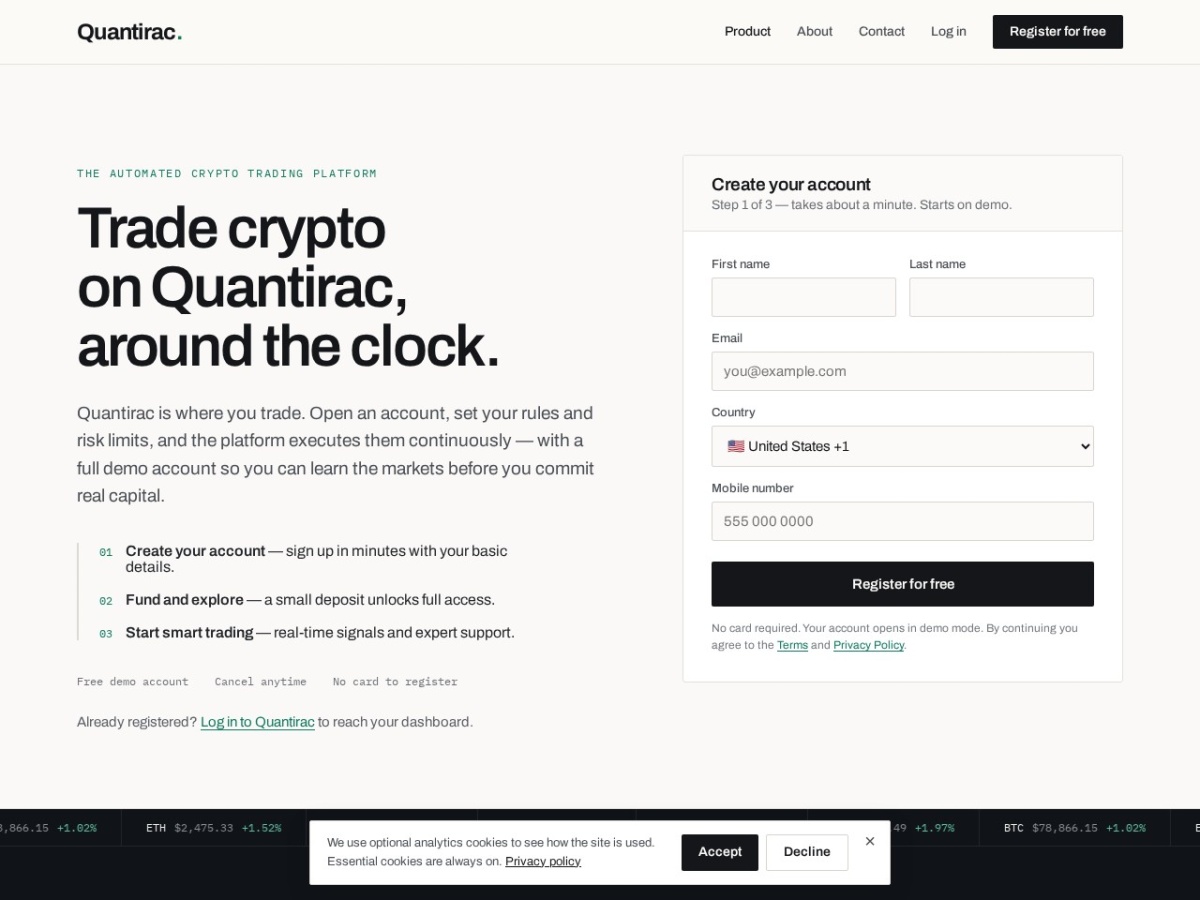
When a platform promises to solve the hardest problem in retail crypto trading—discipline—it either delivers something genuinely useful or it's selling false confidence wrapped in automation. Quantirac positions itself as the former: an all-in-one automated trading platform where you define the rules, set the risk caps, and let software do the work around the clock. But does the service hold up under scrutiny, or is it another subscription trap dressed in convincing UX?
The basic proposition is straightforward. Quantirac is not a signal provider, not a custodian, and not a bolt-on tool for an existing exchange account. It is the platform itself. You register, fund an account, build strategies using a visual editor that requires no coding, and the system executes those strategies against live crypto markets. Every account starts in demo mode with simulated capital running on real market data, which is a critical detail we will return to. There is no minimum term, no profit share, and the pricing model is a flat monthly subscription. You can cancel anytime, and access continues until the end of the billing cycle.
At first glance, this looks reasonable. The value proposition is not moonshot returns or secret algorithms—it is consistency, removal of emotion, and enforcement of predefined risk rules. The company does not promise profits, and the FAQ explicitly states that losses are possible, including total loss of trading capital. That level of candour is rare in this sector and immediately distinguishes Quantirac from the noisier end of the fintech-crypto spectrum, where every landing page seems to guarantee life-changing gains.
What you actually get
The platform offers trading access to major crypto pairs: Bitcoin, Ethereum, Solana, XRP, Cardano, and Chainlink, all settled against stablecoin bases, primarily USDT. The list is not exhaustive, but it covers the assets with enough liquidity and volatility to make automation worthwhile. The company acknowledges that illiquid altcoins are poor candidates for systematic strategies—slippage and erratic fills destroy edges faster than any algorithm can create them. The focus on liquid pairs is pragmatic, not limiting.
You build strategies in a visual editor, selecting from a library of indicators and conditions without writing code. If you do have scripting ability, there is a layer available for custom logic, but the core selling point is accessibility. A person with no programming background can assemble a trend-following or mean-reversion setup in fifteen minutes, backtest it on demo capital, and watch it execute live before committing real funds. The interface consolidates markets, charts, strategy builder, execution engine, and reporting in one environment. There are no third-party tools to wire together, no API keys to generate and rotate, and no synchronisation errors to troubleshoot at two in the morning.
Risk management is built into the platform architecture, not left to user discipline. You configure position size as a percentage of capital, set daily loss caps, define maximum drawdown thresholds, and impose limits on the number of concurrent positions. When any limit is breached, the platform halts trading and sends a notification. It does not renegotiate. It does not give you one more chance. It stops. For anyone who has ever watched a losing position erode an account because "it might come back," this is the feature that justifies the subscription fee.
The demo account and what it reveals
Every Quantirac account opens in demo mode. There is no time limit. You can trade the simulated balance for weeks or months, refine your strategies, observe how the execution engine handles volatile moves, and build confidence—or lose it—before a single dollar of real capital is at risk. This is not a gimmick. It is a filter. A platform that lets you see exactly how it behaves under live market conditions, with no financial commitment, is either very confident in its infrastructure or very transparent about its limitations. Either way, the user benefits.
The demo runs on live market data, so fills and slippage reflect real conditions. This matters because many backtesting environments use idealised historical data that bear no resemblance to execution reality. If your strategy shows a profit in demo and a loss in live trading, the problem is not the platform—it is the strategy. The company is explicit about this: Quantirac applies your rules consistently, but whether those rules make money depends on the strategy, the market, and your risk settings. There is no hand-holding, no promise that the platform will save you from bad decisions. It will simply execute bad decisions more reliably than you would manually, which is both the strength and the risk.
The operational model and what it avoids
One of the most reassuring details, buried in user testimonials but central to the trust equation, is that Quantirac does not take custody of your crypto. Your funds stay on your own exchange account. This is a departure from many automated trading platforms that require you to deposit assets into their ecosystem, where recourse in the event of insolvency or fraud is limited. By avoiding custody, Quantirac sidesteps one of the biggest red flags in retail crypto services. The platform connects to your exchange via API, executes orders on your behalf, but never holds the collateral. If the company disappears tomorrow, your coins remain where you left them.
The pricing model—a flat monthly fee with no profit share—also warrants attention. Profit-sharing arrangements create misaligned incentives: the platform benefits from turnover and volatility regardless of whether you make money. A subscription model aligns interest differently. Quantirac earns the same fee whether you trade once a week or a hundred times a day, whether your account grows or shrinks. The incentive is retention, which depends on the platform being useful enough that users choose to stay. This is not altruism; it is business design that happens to reduce some conflicts of interest.
The company is also transparent about costs. Registration and demo access are free. No card is required to open an account. The subscription begins only when you choose to go live, and you can cancel from the billing page at any time. Access continues to the end of the current period. There are no hidden tiers, no upsells disguised as essential features, and no pressure to commit capital before you are ready. For a sector where dark patterns are the norm, this clarity is notable.
The risk disclosure and what it implies
Quantirac does not guarantee returns. The FAQ addresses this directly: you should be sceptical of anyone who promises profits in crypto trading, and the platform is no exception. Losses are possible, up to and including total loss of capital. This is not buried in the fine print—it is stated plainly in the section where most platforms would be selling dreams.
The company also outlines five specific de-risking practices: size positions before entry, hold a stablecoin reserve, diversify across uncorrelated strategies, automate exits as well as entries, and cap damage per day and per month. These are not novel ideas, but the fact that the platform enforces them structurally, rather than recommending them rhetorically, is significant. A stop-loss configured in software does not panic. A daily loss cap set in advance does not negotiate. The elimination of emotional override is the entire point, and Quantirac delivers it mechanically.
The platform also emphasises that being fully invested at all times is a vulnerability, not a strategy. A standing allocation to stablecoins gives you the ability to respond to drawdowns rather than simply endure them. This is basic portfolio hygiene, but it runs counter to the "always be in the market" mentality that pervades retail crypto culture. The fact that Quantirac treats cash as a position, not a failure state, suggests a more mature approach to risk than many competitors.
The user testimonials and what they avoid saying
The testimonials on the site are placeholder copy, clearly labelled as such, which is either admirable honesty or a sign that the platform is too new to have accumulated genuine user feedback. Either way, the absence of fabricated five-star reviews is a point in its favour. The quotes that are present emphasise specific features—demo mode, risk caps, lack of custody, automation of exits—rather than vague praise or claims of outsized returns. If and when real testimonials replace these placeholders, their credibility will depend on whether they maintain this tone or slide into the usual promotional hyperbole.
What the testimonials do not say is as telling as what they do. There are no claims of users turning small accounts into fortunes. There are no before-and-after screenshots. There is no social proof in the form of influencer endorsements or trading-floor glamour shots. The messaging is relentlessly operational: the platform does what you tell it, enforces the rules you set, and removes the variables you cannot control—mainly yourself. If that value proposition does not appeal to you, Quantirac has little else to offer.
The structural question: is this a scam?
A scam, in the strict sense, is a service that takes money under false pretences and delivers nothing, or delivers something fundamentally different from what was promised. Quantirac does not fit that definition. The platform provides exactly what it claims: automated execution of user-defined strategies on liquid crypto pairs, with risk controls and a demo environment. The fee structure is transparent, cancellation is straightforward, and the company does not take custody of funds. There are no lock-in periods, no withdrawal restrictions, and no opaque fees.
The more relevant question is whether the service is worth the cost, and that depends entirely on what you bring to it. If you have a profitable strategy that suffers from inconsistent execution, emotional interference, or the simple inability to watch markets around the clock, Quantirac solves real problems. If you do not have a profitable strategy, the platform will not create one for you. It will execute a losing strategy more reliably than you would manually, which is not an outcome worth paying for.
The demo account is the test. If you cannot generate positive results on simulated capital over a meaningful sample of trades, there is no reason to expect different results with real money. The platform is a tool, not a solution. It amplifies discipline and removes friction, but it does not substitute for skill or strategy. This is a distinction the company makes clearly, and it is one that potential users would do well to internalise before subscribing.
The verdict: fit for purpose, not a miracle
Quantirac is not a scam. It is a functional, transparent, and structurally sound platform for automating crypto trading strategies. The pricing is clear, the risk disclosures are honest, and the demo environment allows for genuine due diligence before capital is committed. The lack of custody, the absence of profit-sharing fees, and the mechanical enforcement of risk rules all suggest a service designed to solve specific, real problems rather than to extract money from hopeful beginners.
But it is not a shortcut. The platform will not make you a better trader. It will not generate alpha where none exists. It will simply execute your plan more consistently than you would on your own, which is valuable only if the plan itself has merit. The demo account is where that merit reveals itself, or fails to. Anyone considering Quantirac should spend substantial time in demo mode, treat it as seriously as live trading, and let the results speak before committing real funds.
For traders who already know what works but struggle with execution, Quantirac is a tool worth the cost. For those still searching for a strategy, it is premature. The platform does not pretend otherwise, and that honesty, more than any feature, is what separates it from the noisier, more predatory corners of the retail crypto industry.