
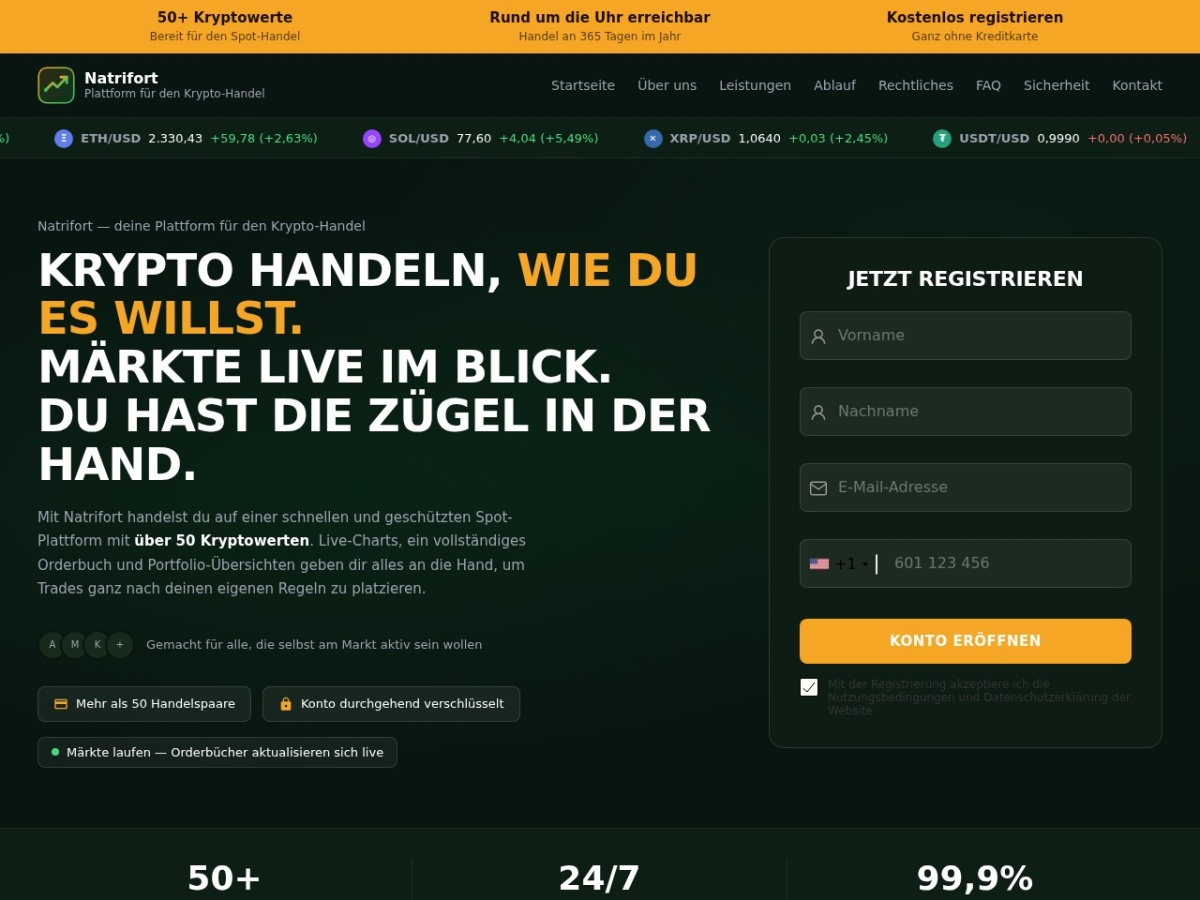
When a new cryptocurrency trading platform appears on the scene, the first question seasoned traders ask is not "What can I earn?" but "Is this real?" The digital asset space has been fertile ground for both innovation and exploitation, and distinguishing between a legitimate service and an elaborate scam requires more than surface-level inspection. Natrifort presents itself as a straightforward spot trading platform offering access to over fifty cryptocurrency pairs with round-the-clock market access. The question is whether it delivers on that promise or whether it hides red flags beneath a polished interface.
The Core Proposition
Natrifort positions itself as a platform built for traders who want direct market access without intermediaries making decisions on their behalf. The service emphasizes that it does not trade autonomously in user accounts and makes no guaranteed return promises. This is a crucial distinction. Many fraudulent platforms in the crypto space lure users with the prospect of fixed yields or automated trading bots that supposedly generate consistent profits. Natrifort explicitly distances itself from that model, stating that users receive charts, order types, and account functions to implement their own strategies.
The platform offers more than fifty trading pairs, claims availability around the clock, and provides a live order book alongside price charts. Users can execute market orders, limit orders, and stop orders, which are standard tools in any legitimate trading environment. The interface is described as cloud-based, accessible from any device without installation, and designed to serve both newcomers and experienced traders. On paper, these are the hallmarks of a modern exchange. In practice, the credibility of such claims hinges on transparency, regulatory compliance, and user experience.
Registration and Identity Verification
One of the immediate tests of legitimacy is how a platform handles user onboarding. Natrifort describes a four-step process: account creation with an email address and secure password, identity verification, deposit, and then trading. The inclusion of an identity check is significant. While it may seem like an inconvenience, mandatory verification is a regulatory requirement in most jurisdictions for platforms handling fiat-to-crypto conversions or large transaction volumes. Fraudulent operations often skip this step entirely or make it optional, enabling money laundering and leaving users without recourse in case of disputes.
That said, the presence of identity verification alone does not guarantee legitimacy. Some scam platforms collect personal documents under the guise of compliance, only to misuse the information or disappear before users can withdraw funds. The real test comes later, during the withdrawal process. A legitimate platform processes withdrawals within a defined timeframe and does not invent reasons to block access to user funds. Natrifort mentions that withdrawal requests are reviewed and processed within a set window before funds are sent to the registered payment method or wallet address, but this claim can only be validated through sustained user experience and third-party audits.
Fee Structure and Transparency
Transparency in fee disclosure is another litmus test. Natrifort provides an interactive fee calculator on its site, showing estimated costs for maker and taker orders. The example given uses a maker fee of 0.10% and a taker fee of 0.20% on a hypothetical order volume. These rates fall within the industry norm for spot trading on mid-tier exchanges. High-volume traders on established platforms often pay less, while smaller venues may charge more. The key point is that the fees are stated upfront rather than buried in fine print or revealed only after a transaction is completed.
However, the platform includes a disclaimer that actual fees depend on account tier and order type, which is standard practice. Volume-based fee tiers incentivize liquidity provision and are a feature of legitimate exchanges. What matters here is whether users encounter unexpected charges during withdrawal or conversion. Hidden fees are a classic tactic of predatory platforms. A legitimate service will display all costs, including network fees and conversion spreads, before a user confirms an action.
Security Measures and Cold Storage
Security infrastructure is where many scam platforms collapse under scrutiny. Natrifort lists several protective measures: encrypted account data and API connections, offline cold storage for the majority of reserves, two-factor authentication, and confirmation emails for every withdrawal. These are not revolutionary features but they are essential baselines. The mention of cold storage is particularly important. In the wake of high-profile exchange collapses and hacks, users have become acutely aware that platforms holding all assets in hot wallets are vulnerable to theft.
Cold storage means that the bulk of user funds are kept in offline wallets, inaccessible to hackers targeting the platform's servers. Only the liquidity needed for daily operations remains online. This practice reduces risk but does not eliminate it. The credibility of such claims depends on independent audits and proof-of-reserves disclosures, which are not mentioned in the provided material. A platform that refuses to undergo third-party security audits or provide verifiable proof of asset reserves should be approached with caution, regardless of how polished its marketing appears.
The platform also highlights the ability for users to set stop-loss and take-profit markers on individual trades, allowing them to manage risk according to their own judgment. This is a standard feature on legitimate exchanges and reflects a user-centric design philosophy. The inclusion of biometric login on mobile devices and mandatory re-confirmation for sensitive actions adds layers of defense against unauthorized access.
No Guaranteed Returns
One of the most reassuring aspects of Natrifort's messaging is its explicit rejection of guaranteed profits. The site states clearly that trading involves risk, that users can lose their entire investment, and that the platform does not execute trades on behalf of users or promise fixed returns. This is the opposite of what scam platforms typically advertise. Fraudulent schemes often dangle the prospect of consistent monthly returns, algorithmic trading bots with perfect track records, or insider access to pre-launch tokens. These promises are designed to bypass rational skepticism and appeal to greed.
Natrifort's approach aligns with the reality of financial markets: returns are uncertain, risk is inherent, and the user bears full responsibility for their trading decisions. This does not mean the platform is above criticism or immune to operational failure, but it does suggest a foundation of honesty rather than deception. The inclusion of risk warnings throughout the site, including the statement that the page is a demo template and does not constitute financial advice, further reinforces this stance.
User Experience and Accessibility
The platform's design philosophy centers on accessibility without sacrificing functionality. The interface is described as clean, with live market data, a complete order book, portfolio overviews, and trade history all integrated into a single dashboard. The absence of mandatory downloads or installations lowers the barrier to entry, particularly for users who do not want to commit storage space or manage software updates. Cloud-based platforms also enable seamless access across devices, which is a practical advantage for traders who monitor markets on the go.
For beginners, Natrifort offers optional guided onboarding and includes a glossary of trading terms. This is a thoughtful touch. Many newcomers to crypto trading are intimidated by jargon and unfamiliar order types. Providing educational resources within the platform itself can reduce mistakes and improve user confidence. However, the effectiveness of these resources depends on their depth and accuracy, which cannot be assessed from promotional material alone.
Red Flags to Watch For
While the information provided by Natrifort does not immediately reveal classic scam indicators, there are questions that independent reviews must address. The first is regulatory status. The material does not mention licensing, registration with financial authorities, or compliance with specific jurisdictions. Legitimate exchanges operating in regulated markets typically display their licenses prominently. The absence of this information does not prove fraud, but it does leave a gap that should be filled through further research.
Second, the claim of a referral or partnership program is mentioned in the FAQ section but not elaborated upon. Pyramid schemes and multi-level marketing structures have plagued the crypto industry, and any platform offering incentives for user recruitment should disclose the terms clearly. Legitimate referral programs reward users for bringing in new traders but do not require those users to recruit others or promise escalating rewards based on downline activity.
Third, the site includes a warning about phishing attempts. It states that messages asking for passwords or seed phrases are likely fraud and that Natrifort will never request such information unsolicited. This is good advice, but the inclusion of the warning also reflects the reality that platforms in this space are frequent targets of impersonation scams. Users must verify they are interacting with the genuine site, not a clone designed to harvest credentials.
The Importance of Independent Verification
No review of a trading platform can replace personal due diligence. Potential users should search for independent testimonials, complaints filed with regulatory bodies, and discussions on forums where traders share experiences. The absence of red flags in official material does not mean a platform is infallible. Operational issues, customer service failures, and liquidity problems can all affect the user experience without crossing into outright fraud.
It is also worth checking whether the platform has faced legal action, whether its operators are publicly identified, and whether it maintains transparent communication channels. Anonymous teams are not inherently dishonest, but they do increase risk. If something goes wrong, users have no recourse if the people behind the platform cannot be held accountable.
Conclusion
Natrifort presents itself as a no-frills spot trading platform with a focus on user control, transparency, and security. It avoids the most glaring red flags associated with crypto scams: it does not promise guaranteed returns, it requires identity verification, it discloses fees, and it emphasizes that users are responsible for their own trading decisions. These are positive signals, but they are not proof of legitimacy. The platform's credibility will ultimately be determined by its track record, regulatory standing, and whether users can reliably deposit, trade, and withdraw funds without obstruction.
For traders considering Natrifort, the advice is straightforward. Start with a small deposit, test the withdrawal process, verify that customer support responds promptly, and watch for any signs of inconsistency between the platform's promises and its performance. No platform is risk-free, and even established exchanges have faced failures. The question is not whether Natrifort is perfect but whether it operates honestly, respects user funds, and provides the tools it advertises. Only time and independent scrutiny can answer that question definitively.
The factual information and data for this article were provided by Natrifort through its website https://natrifort.com.de/, which served as the primary source for the details about features, fees, and security measures described in this review.