
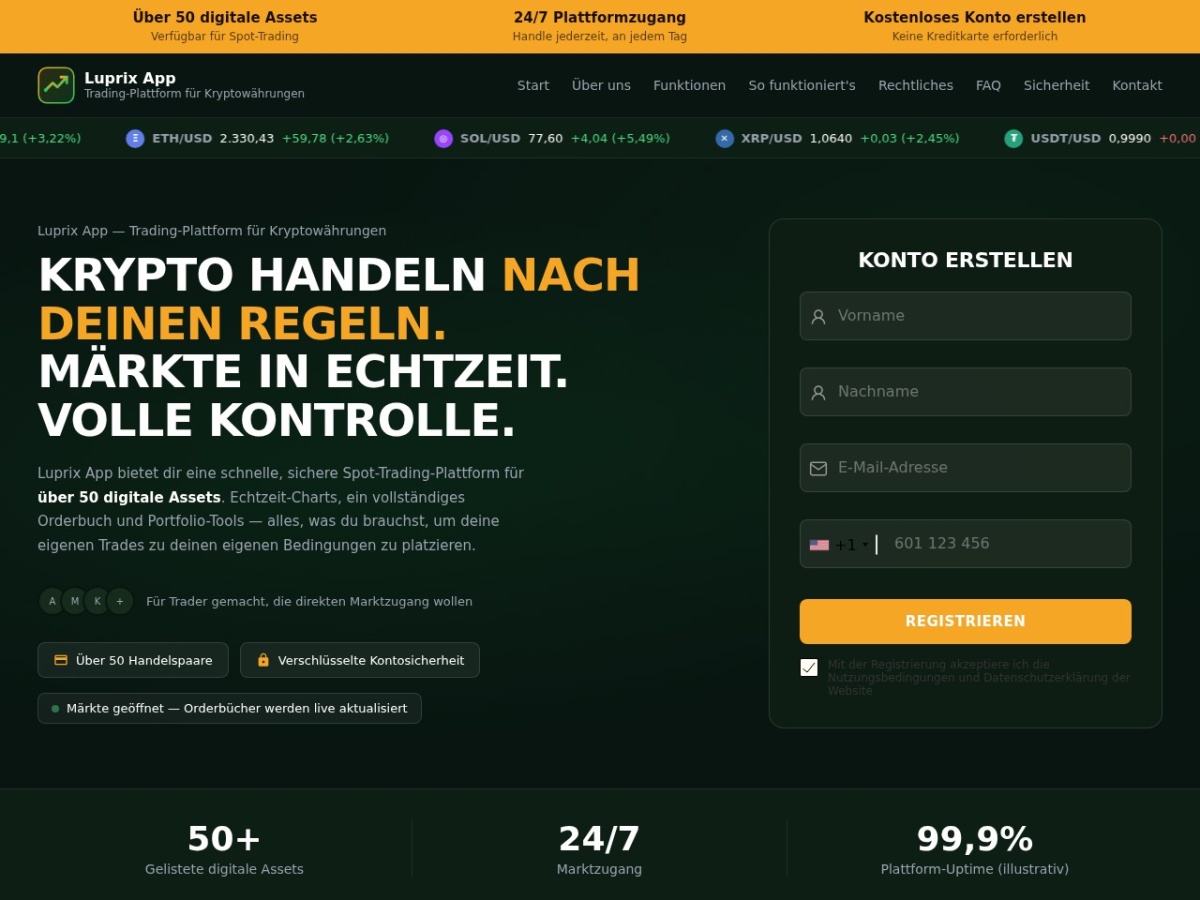
When a new trading platform appears online promising easy access to crypto markets, the first question any cautious investor should ask is simple: is this legitimate, or am I about to hand my money to a well-designed scam? That question has followed Luprix App since it began attracting attention among retail traders looking for a straightforward spot-trading environment. This review examines what Luprix App claims to offer, how it positions itself in a crowded and frequently dishonest marketplace, and whether the red flags outnumber the green lights.
What Luprix App Claims to Be
According to its own materials, Luprix App presents itself as a spot-trading platform for digital assets—specifically, cryptocurrencies. The company states it offers access to more than fifty trading pairs, around-the-clock market access, and a suite of tools including real-time order books, limit and stop orders, and portfolio tracking. The pitch is built around control: the platform does not trade on your behalf, does not promise returns, and positions itself as a neutral infrastructure layer where you make your own decisions.
That positioning is important. Many platforms that later turn out to be scams begin by promising guaranteed returns, algorithmic trading bots that never lose, or invitation-only investment pools with suspiciously high monthly payouts. Luprix App, at least on paper, avoids those tropes. It describes itself as a terminal—a place to execute your own strategy, not a fund manager or automated arbitrage miracle. That alone does not prove legitimacy, but it does suggest a different sales approach.
The platform claims to support market orders, limit orders, and stop-loss functionality, all of which are standard tools in legitimate exchange environments. It also describes itself as cloud-based, accessible from any device without downloads or installations, and secured with two-factor authentication, session encryption, and cold storage for reserve funds. Again, these are the features you would expect from a real exchange, but they are also the features that every sophisticated scam now includes in its marketing copy.
The User Experience: Simple, But Not Necessarily Safe
Luprix App outlines a four-step onboarding process: account creation, identity verification, deposit, and then trading with the option to withdraw at any time. The identity verification step is worth noting. Legitimate platforms are required to perform Know Your Customer checks under most jurisdictions' anti-money-laundering regulations. Scam platforms sometimes skip this step entirely, or perform fake verification that never actually checks anything. The fact that Luprix App mentions identity verification is a point in its favor, but without independent confirmation of what that process entails or which third-party service handles it, the claim remains unverified.
The platform's interface is described as beginner-friendly, with an integrated glossary and optional guided tour. That is a smart design choice for a legitimate service trying to attract new users, but it is also a common feature in scam platforms that want to appear professional and accessible. The absence of a minimum deposit figure in the provided materials is notable—most legitimate exchanges publish clear deposit and withdrawal minimums, along with fee schedules. Luprix App does mention maker and taker fees, with examples of zero point one percent for maker orders and zero point two percent for taker orders, but these figures are described as illustrative rather than contractual.
Security Features: Standard, but Hard to Verify
The platform lists several security measures: encrypted data transmission, two-factor authentication, cold storage for the majority of reserves, and email confirmations for withdrawals. These are industry-standard practices, and any platform that does not offer them should be avoided outright. However, the presence of these features on a marketing page does not confirm they are implemented correctly, or at all.
Cold storage, for example, is a term that gets thrown around frequently. It means keeping the bulk of user funds offline, in wallets that are not connected to the internet and therefore cannot be remotely hacked. A legitimate exchange will have regular third-party audits to verify the existence and security of those cold wallets. Luprix App makes the claim but provides no evidence of external audits, proof-of-reserves, or transparency reports. That does not mean the cold storage does not exist, but it does mean users are being asked to take the platform's word for it.
Similarly, encryption and two-factor authentication are only as strong as the systems that implement them. A scam platform can easily claim to use these technologies while running insecure infrastructure behind the scenes. Without independent security assessments or public incident response records, it is impossible to evaluate the true strength of Luprix App's defenses.
Red Flags and Missing Information
Several elements raise concerns. First, the platform's materials repeatedly describe figures and features as "illustrative" or "demo template" content. This language appears throughout the site, including in sections describing uptime statistics, order execution speeds, and fee structures. While it is possible this reflects a pre-launch or beta version of the platform, it also creates ambiguity about what is real and what is placeholder content. A legitimate platform preparing for launch would typically make clear distinctions between live data and example content, and would publish binding terms of service that replace illustrative language with contractual commitments.
Second, there is no information about the company's legal structure, jurisdiction of incorporation, regulatory licenses, or leadership team. Legitimate exchanges operating in regulated markets are required to disclose this information publicly. The absence of such disclosures does not automatically mean fraud, but it does mean the platform is either operating in an unregulated jurisdiction, is not yet fully launched, or is deliberately avoiding scrutiny. None of those scenarios inspire confidence.
Third, the FAQ section includes a question about whether the platform guarantees returns, and the answer is no—which is correct and honest. But the same section also includes vague reassurances about security and withdrawals without providing specific timelines, support contact methods, or escalation procedures. Legitimate platforms have detailed support infrastructures and published response times. The lack of specificity here is troubling.
Fourth, the site includes a warning advising users to be vigilant about phishing attempts and never to share passwords or seed phrases with anyone claiming to represent Luprix App. That is good advice, and it is encouraging that the platform includes it. However, it also reflects awareness that the platform's name might already be used in phishing schemes—a common problem for both legitimate services and scams that have gained enough visibility to attract imitators.
What Independent Sources Say—Or Don't
One of the strongest indicators of legitimacy is independent verification: reviews from established crypto media outlets, security audits by reputable firms, user testimonials on third-party forums, or mentions in regulatory filings. At the time of writing, there is limited independent information available about Luprix App. A search of major crypto news sites, review aggregators, and regulatory databases does not turn up significant discussion, which could mean the platform is very new, has not yet attracted attention, or is deliberately flying under the radar.
The absence of reviews is not proof of fraud, but it is a reason for caution. Scam platforms often appear with polished websites and strong marketing but vanish quickly once users report problems withdrawing funds. Legitimate platforms, by contrast, accumulate a track record over time—user reviews, media coverage, regulatory filings, and public responses to security incidents. Luprix App does not yet have that track record, which means any user considering the platform is, in effect, an early adopter taking on additional risk.
The Verdict: Approach with Extreme Caution
So, is Luprix App a scam or legitimate? The honest answer is that the available evidence does not allow for a definitive conclusion. The platform presents itself with the language and features of a legitimate spot-trading service. It avoids some of the most obvious red flags—such as guaranteed returns, multi-level referral schemes, or promises of algorithmic wealth generation. It includes standard security features and positions itself as a neutral infrastructure provider rather than an investment advisor.
However, the platform also lacks the transparency, regulatory clarity, and independent verification that would be expected of a fully legitimate and trustworthy service. The repeated use of "illustrative" disclaimers, the absence of clear legal and regulatory information, and the lack of third-party reviews or audits all suggest a platform that is either very early in its lifecycle or operating in a grey area of compliance.
For potential users, the prudent course is clear: do not deposit funds until you can verify the platform's legitimacy through independent sources. Look for regulatory licenses, third-party security audits, and reviews from users who have successfully withdrawn funds. If you do choose to test the platform, start with the smallest possible amount, verify that withdrawals work as promised, and never deposit more than you can afford to lose entirely.
The crypto trading space is filled with platforms that look professional, sound credible, and ultimately disappear with user funds. Until Luprix App can demonstrate a track record of transparency, regulatory compliance, and user satisfaction, it should be treated as high-risk. That does not mean it is a scam, but it does mean the burden of proof has not yet been met.
A Note on Sources
The factual information and company details used in this review were provided by Luprix App via its website, https://luprix.app/. All claims about features, security measures, and platform functionality reflect the company's own statements and have not been independently verified. Readers are encouraged to conduct their own research and consult with financial advisors before engaging with any trading platform.