
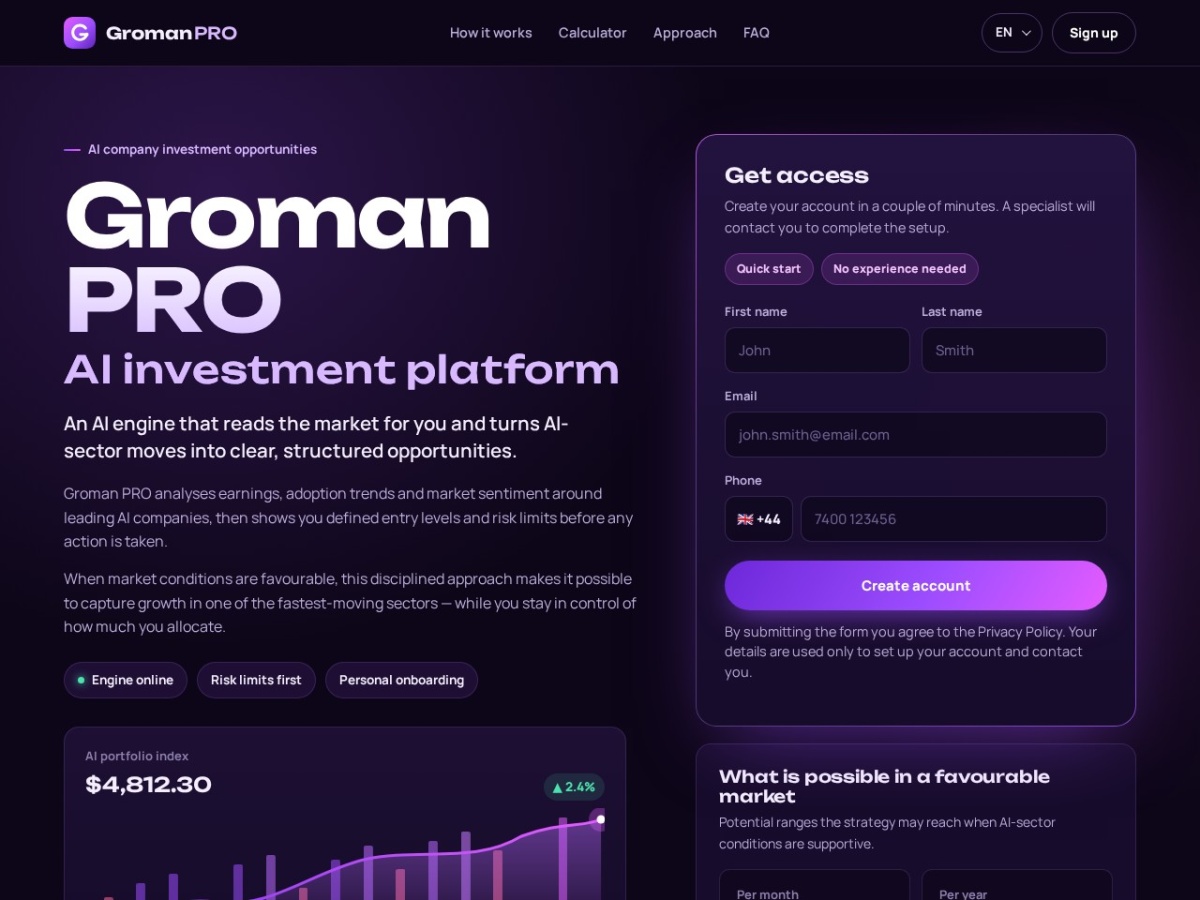
When a platform promises AI-driven investment opportunities in one of the hottest sectors of the global economy, the natural first question isn't "how much can I make?" but rather "is this real, or am I about to hand my money to a nicely designed landing page?" That's the lens through which I approached Groman PRO, a service that positions itself as an automated AI engine for tracking and entering positions in AI-sector companies. After reviewing the platform's mechanics, structure, and transparency—or lack thereof—here's what I found.
What Groman PRO Claims to Be
At its core, https://groman.pro/ describes itself as an AI-powered investment platform designed to analyse market data around companies involved in artificial intelligence development, adoption, and infrastructure. The promise is straightforward: the system monitors earnings, sentiment, and adoption trends across AI stocks, then identifies what it calls "structured opportunities" with predefined entry levels and risk limits. Users don't need to watch the market themselves; the engine does the scanning, filtering, and execution within parameters set by the investor.
The platform targets people who don't have the time or experience to actively manage their own portfolios but want exposure to a fast-moving sector. It offers onboarding support through a personal specialist, a transparent workflow that shows why each action is taken, and a rules-based approach meant to reduce emotional decision-making. On paper, it sounds like a sensible middle ground between passive index investing and active day trading.
The Numbers: What the Platform Shows
Groman PRO doesn't hide behind vague language when it comes to potential returns, and that's both refreshing and concerning. The platform openly states that in favourable market conditions, monthly returns of eight to fifteen percent are possible, with annual ranges between eighty and one hundred fifty percent. These figures are accompanied by disclaimers that results depend on market conditions and can be lower or even negative in weak markets, but the headline numbers are prominent enough to catch attention.
The site includes a return calculator that lets prospective users input an amount and timeframe to see a projected outcome. For example, an investment of nineteen thousand nine hundred dollars over a ten-month period could theoretically grow to twenty-four thousand five hundred seventeen dollars, yielding a profit of four thousand six hundred seventeen dollars. The platform describes this as an illustration of a favourable scenario, not a forecast or promise, but the tool itself is designed to let users visualise upside.
An illustrative twelve-month model scenario shows a starting capital of seventeen thousand two hundred dollars growing to twenty-five thousand eight hundred dollars, a fifty percent return. The model assumes eight positive months, two flat months, and a best month of fifteen percent. Again, the platform emphasises that this is a model, not a guarantee, but the recurring theme is clear: the system wants you to imagine what's possible when things go well.
Market Context: Why AI, Why Now
To its credit, Groman PRO does offer some context for why it's focusing on AI companies. The platform cites a total AI market scale of four point eight trillion dollars over twelve months, with growth of six hundred ninety billion dollars. It breaks this into three segments: AI leaders valued at three point four trillion dollars with thirty-one percent growth, AI growth companies at one point eight trillion dollars with twenty-seven point six percent growth, and AI infrastructure at one trillion dollars with forty-two point three percent growth.
These figures paint a picture of a sector with both established demand and expansion potential. The platform argues that earnings momentum, enterprise adoption, new product launches, and investor activity are the main factors moving the market, while interest rates, sentiment, and liquidity add short-term volatility. The engine, according to Groman PRO, accounts for these factors in its risk limits.
Whether those market figures are independently verified or sourced from the company's own analysis isn't specified, and that's a gap. The numbers sound plausible—AI has been one of the fastest-growing areas of the global economy—but without citation or third-party confirmation, they should be taken as the platform's framing rather than objective fact.
How the System Works
The operational model is presented in four steps. First, you create an account by filling out a short form. Second, a specialist contacts you to confirm details and explain the platform. Third, you set your investment amount and preferred risk level. Fourth, the AI engine takes over, monitoring the market and adjusting positions within your predefined limits.
The engine itself operates in a continuous cycle: it scans market activity, identifies opportunities that meet its criteria, and executes positions while applying risk controls. Signal latency is stated as under one second, with ninety-nine point nine percent uptime and twenty-four-seven market monitoring. Every action follows what the platform calls a "traceable workflow," meaning users can see the logic behind each decision—from the first signal to the final position.
This level of transparency is a positive sign. Many automated trading platforms function as black boxes, leaving users with little understanding of why their money is moving in or out of positions. If Groman PRO genuinely offers visibility into the decision-making process, that's a meaningful differentiator. The question is whether that transparency extends to third-party audits, verifiable track records, or independent oversight—and the platform's materials don't address that.
Who It's For—and Who Should Stay Away
Groman PRO is explicit about its target audience. It's designed for people who don't have time to manage investments actively, who are new to investing or prefer a guided approach, who want to avoid impulsive high-risk decisions, and who like a clear process with built-in automation. It's not for people who want to place and manage every trade themselves, who aren't comfortable with AI-supported decisions, who prefer high-risk short-term speculation, or who expect instant results or guaranteed profit.
That self-awareness is useful. The platform isn't pretending to be all things to all investors. It's positioning itself as a structured, technology-led solution for a specific type of user. But it's worth noting that the people most likely to be attracted to this service—those with limited experience and a desire for automation—are also the most vulnerable to overpromising platforms. The onus is on Groman PRO to prove it's not exploiting that dynamic.
Red Flags, Yellow Flags, and Green Flags
Let's be honest about the concerns. The return figures, even with disclaimers, are aggressive. Eight to fifteen percent per month is venture-capital-level performance, and sustained results in that range would outpace the vast majority of professional hedge funds. The fact that the platform presents these as possible outcomes in favourable conditions doesn't eliminate the risk that users will anchor their expectations to those numbers and be disappointed—or worse, make decisions based on optimism rather than reality.
The lack of verifiable track record is another issue. The platform doesn't publish audited performance data, third-party reviews, or regulatory filings that would allow an independent observer to verify claims. It's possible that Groman PRO is a new entrant and simply hasn't built that history yet, but in the world of investment platforms, absence of evidence is a caution sign.
On the other hand, there are elements that suggest legitimacy. The platform doesn't promise guaranteed returns or claim to have a secret formula. It openly acknowledges that markets can move against you and that losses are possible. It provides a clear onboarding process with human support, rather than relying solely on automated sign-ups. It emphasises risk controls and predefined limits, which are hallmarks of disciplined investment management. And it offers transparency into the logic behind each action, which is more than many retail trading platforms provide.
The use of AI as a decision-support tool is neither a red flag nor a guarantee of quality. AI-driven analysis is a legitimate and increasingly common approach in finance, but it's only as good as the data it's fed, the models it's built on, and the oversight that governs it. Without visibility into how Groman PRO's engine is trained, tested, and monitored, it's difficult to assess whether the AI component adds real value or is primarily a marketing angle.
The Verdict: Proceed with Caution and Questions
So, is Groman PRO a scam or legit? Based on the information available, it doesn't exhibit the hallmarks of an outright scam. It's not asking for payment through untraceable channels, it's not making legally impossible guarantees, and it's not hiding behind anonymous ownership. It presents a structured process, offers human support, and acknowledges risk. That puts it in a different category from the fly-by-night schemes that populate the fringes of the investment world.
But legitimate doesn't mean safe, and it doesn't mean smart. The platform is offering access to a volatile sector using an automated system with unproven performance. The return projections, while technically qualified, are high enough to raise eyebrows. The lack of independent verification, regulatory clarity, and third-party oversight means that prospective users are largely taking the platform at its word.
If you're considering Groman PRO, here's what you should do before committing any capital. First, ask the specialist who contacts you for verifiable performance data—not hypothetical models, but actual historical returns with context. Second, ask about regulatory status: is the platform registered with any financial authority, and if not, why not? Third, ask about fund security: where is your money held, who has access to it, and what protections are in place if the platform fails? Fourth, start with the smallest amount you're willing to lose entirely, and treat it as a test rather than an investment strategy.
The AI sector is real, the opportunity is real, and the demand for accessible investment tools is real. Whether Groman PRO is the right vehicle for capturing that opportunity depends on answers the platform hasn't yet made public. Until those answers are clear, the smart move is to stay sceptical, ask hard questions, and remember that if the upside sounds too good to be true, the downside is probably larger than you think.
---
Source note: The factual data, service details, and figures used in this article were provided by Groman PRO via https://groman.pro/. All analysis and opinions are the author's own.