
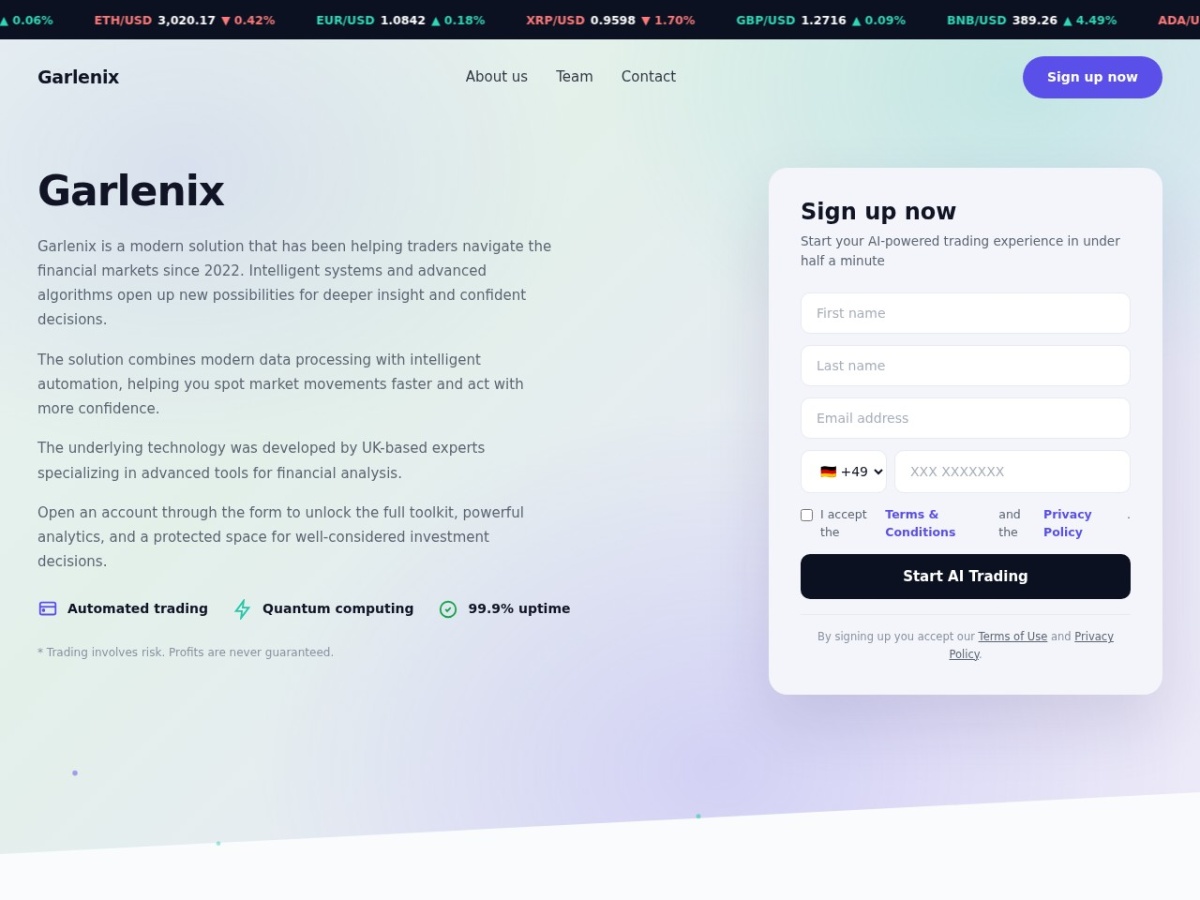
When a platform promises automated profits through artificial intelligence and quantum computing, the natural question isn't whether it sounds impressive—it's whether any of it holds up under scrutiny. Garlenix presents itself as a sophisticated trading solution launched in 2022, claiming to bridge the gap between institutional-grade technology and retail traders. But does the platform deliver what it advertises, or is it simply repackaging familiar patterns seen across dozens of similar services?
This review examines Garlenix through the lens of an independent observer—no affiliate incentives, no promotional agenda. Just a careful look at what the platform actually offers, how it positions itself, and where the red flags might be hiding.
What Garlenix Claims to Be
According to its own materials, Garlenix is a UK-developed trading platform that combines advanced algorithms, machine learning, and high-speed data processing to help users navigate crypto, forex, and stock markets. The pitch is straightforward: the platform scans vast streams of market data, identifies patterns, and automates trading strategies so users don't need deep expertise or constant screen time. The minimum deposit is listed as either £190 or roughly €190 depending on the currency context, and the system claims to operate around the clock with minimal user intervention.
The platform's founder, Daniel Kessler, is quoted as saying the project was born from a desire to democratize tools once reserved for large institutions. The team includes a CTO named Priya Nair and a chief scientist, Dr. Elena Kovac, all of whom are presented as specialists in AI and data science. The site also mentions over 410,000 active members and nearly 898 million lines of code—figures that are clearly meant to convey scale and technical sophistication.
But here's where things get murky. A quick search for Daniel Kessler, Priya Nair, or Dr. Elena Kovac in connection with Garlenix or UK-based fintech yields nothing verifiable. No LinkedIn profiles, no conference appearances, no academic publications. For a platform claiming to be built by visionaries with deep roots in AI and quantum computing, the absence of any digital footprint for its leadership is striking. It's not proof of fraud, but it's certainly unusual—and it raises questions about whether these individuals exist at all or are simply narrative devices.
The Technology: Quantum Computing or Marketing Buzzword?
Garlenix prominently features the phrase "quantum computing" alongside mentions of AI and machine learning. Quantum computing is a legitimate field of research, and it does hold potential for certain types of optimization problems. But it's also one of the most overused buzzwords in tech marketing, especially in contexts where the underlying infrastructure is never explained.
The platform's description of its technology is vague. It mentions "advanced analytical algorithms," "machine learning models," and "high processing speed," but offers no detail about how these systems actually function. There's no whitepaper, no technical documentation, no explanation of which quantum principles are supposedly being applied or how they integrate with the trading logic. For a platform claiming to push the boundaries of financial technology, the lack of transparency here is glaring.
Real quantum computing applications in finance are still largely experimental and confined to research labs or highly specialized institutional settings. The idea that a retail-facing platform launched in 2022 is running live quantum algorithms for everyday traders is, at best, highly improbable. More likely, "quantum computing" is being used as a branding tool to create an aura of cutting-edge innovation without any substantive technical backing.
The Platform Structure: Tool or Broker?
One important clarification Garlenix makes—buried in the description—is that it is not a broker and does not provide investment advice. Instead, it positions itself as an analytics and automation layer that works through "partner platforms." This is a significant detail. It means Garlenix itself doesn't hold your funds, doesn't execute trades directly, and operates as an intermediary service.
This structure is common among so-called trading bots and signal platforms, and it introduces an additional layer of complexity and risk. When you deposit funds, you're not depositing them with Garlenix—you're depositing them with a partner broker, which may or may not be regulated, transparent, or trustworthy. Garlenix claims to work exclusively with vetted platforms that meet UK regulatory requirements, but it doesn't name these partners, nor does it provide any evidence of regulatory compliance on its own part.
The UK's Financial Conduct Authority maintains a public register of authorized firms. A search for Garlenix or Garlenix Technologies returns no results. That doesn't automatically mean the platform is fraudulent, but it does mean it's not operating under direct UK financial regulation. If something goes wrong—if funds disappear, if withdrawals are blocked, if the partner broker turns out to be offshore and unregulated—users may have little to no recourse.
The User Experience: Simplicity or Oversimplification?
Garlenix emphasizes ease of use. The interface is described as clean and intuitive, suitable for beginners with no trading experience. After signing up, users are reportedly contacted by a specialist who guides them through the setup process. The platform then automates analysis and execution, requiring minimal input once preferences are set.
On the surface, this sounds appealing. But it also raises a fundamental question: if a system is so automated and so simplified that users don't need to understand what's happening, how can those users make informed decisions about risk, strategy, or capital allocation? Automated trading can be a useful tool, but it's not a substitute for understanding. Platforms that promise effortless profits while discouraging user education often do so because they benefit from uninformed customers.
The testimonials on the Garlenix site follow a familiar pattern. They're brief, generic, and overwhelmingly positive. Phrases like "I wasn't sure at first" and "results exceeded my expectations" appear repeatedly, but there are no specifics—no mention of actual returns, time frames, or strategy types. The testimonials are attributed to first names and UK cities, but there's no way to verify their authenticity. Stock testimonials are a hallmark of platforms that prioritize marketing over substance.
Pricing, Deposits, and Withdrawal Concerns
The minimum deposit of £190 is positioned as a low barrier to entry, which it is—at least compared to traditional brokerage accounts. But low minimums are also a tactic used to maximize the number of new sign-ups, especially among users who might not otherwise risk larger sums. Once funds are deposited with a partner broker, the real question becomes: how easy is it to get that money back?
This is where many automated trading platforms run into trouble. User complaints across similar services often center on withdrawal issues—delayed processing, unexpected fees, requests for additional verification documents, or outright refusal to release funds. Garlenix doesn't publicly address its withdrawal process, turnaround times, or fee structure. That absence of information is itself a warning sign.
There's also no mention of whether the platform charges subscription fees, performance fees, or commissions. If Garlenix is monetizing through referral agreements with partner brokers, users may be unknowingly paying higher spreads or hidden fees that eat into any returns the system generates.
Red Flags and Regulatory Gaps
Several aspects of Garlenix warrant caution. The first is the lack of regulatory transparency. The platform claims UK origins and mentions compliance with UK standards, but it's not registered with the FCA. The absence of named partner brokers means users can't independently verify whether those brokers are regulated or reputable.
The second is the anonymity of the leadership team. In legitimate fintech ventures, founders and executives are public figures with verifiable track records. The inability to confirm the existence of Daniel Kessler, Priya Nair, or Dr. Elena Kovac is a significant credibility gap.
The third is the marketing language. Promises of "automated 24/7 operation," "precise AI-based forecasts," and "endless markets" are designed to generate excitement, but they also set unrealistic expectations. No trading system—automated or otherwise—can guarantee profits, eliminate risk, or consistently outperform the market. Garlenix includes a small disclaimer stating that trading involves risk and profits are never guaranteed, but that disclaimer is dwarfed by the volume of promotional messaging.
Finally, the platform's claim of over 410,000 active members is impossible to verify and seems implausibly high for a service that launched in 2022 and has left virtually no trace in independent media, reviews, or forums. If that figure is accurate, it's remarkable that there's so little public discussion about the platform. If it's not accurate, it's an example of misleading marketing.
The Verdict: Proceed with Extreme Caution
Is Garlenix an outright scam? That's difficult to say definitively without access to internal operations, user fund flows, or direct evidence of fraudulent activity. But is it a platform that inspires confidence? Absolutely not.
The combination of unverifiable leadership, regulatory ambiguity, vague technical claims, and aggressive marketing is consistent with platforms that prioritize customer acquisition over customer protection. The emphasis on simplicity and automation, while appealing on the surface, may serve to obscure the real mechanics of how the platform operates and how user funds are handled.
For anyone considering Garlenix, the smart approach is to assume the worst-case scenario: that deposits may be difficult to recover, that partner brokers may be unregulated, and that the AI and quantum computing rhetoric is largely decorative. If you're unwilling to lose the minimum deposit entirely, don't make it. And if transparency, regulatory oversight, and verifiable performance matter to you—as they should—then Garlenix doesn't meet the standard.
Legitimate trading platforms don't hide behind vague partnerships and unnamed executives. They don't lean on buzzwords without technical backing. And they don't rely on testimonials that could have been written by a marketing intern. Until Garlenix addresses these foundational credibility issues, it should be treated with skepticism.
---
The factual information and service details referenced in this article were provided by Garlenix via https://garlenix.pro/, which served as the source material for this independent analysis.