
When cryptocurrency trading platforms multiply faster than the coins themselves, skepticism becomes not just healthy—it's mandatory. Edge Fintralis has entered a market saturated with promises of automated wealth, AI-driven insights, and minimal effort. The central question isn't whether such platforms can work in theory—some do—but whether this particular one delivers on its specific claims, operates transparently, and treats user funds with the seriousness they deserve.
After examining the platform's structure, security protocols, fee transparency, and operational claims, a nuanced picture emerges. Edge Fintralis appears to be a legitimate trading platform built around algorithmic automation, but like any financial service operating in the volatile crypto space, it carries inherent risks that no amount of AI sophistication can entirely eliminate. Understanding what the platform actually offers—versus what newcomers might hope it offers—is essential before committing capital.
The Core Proposition: What Edge Fintralis Actually Claims to Do
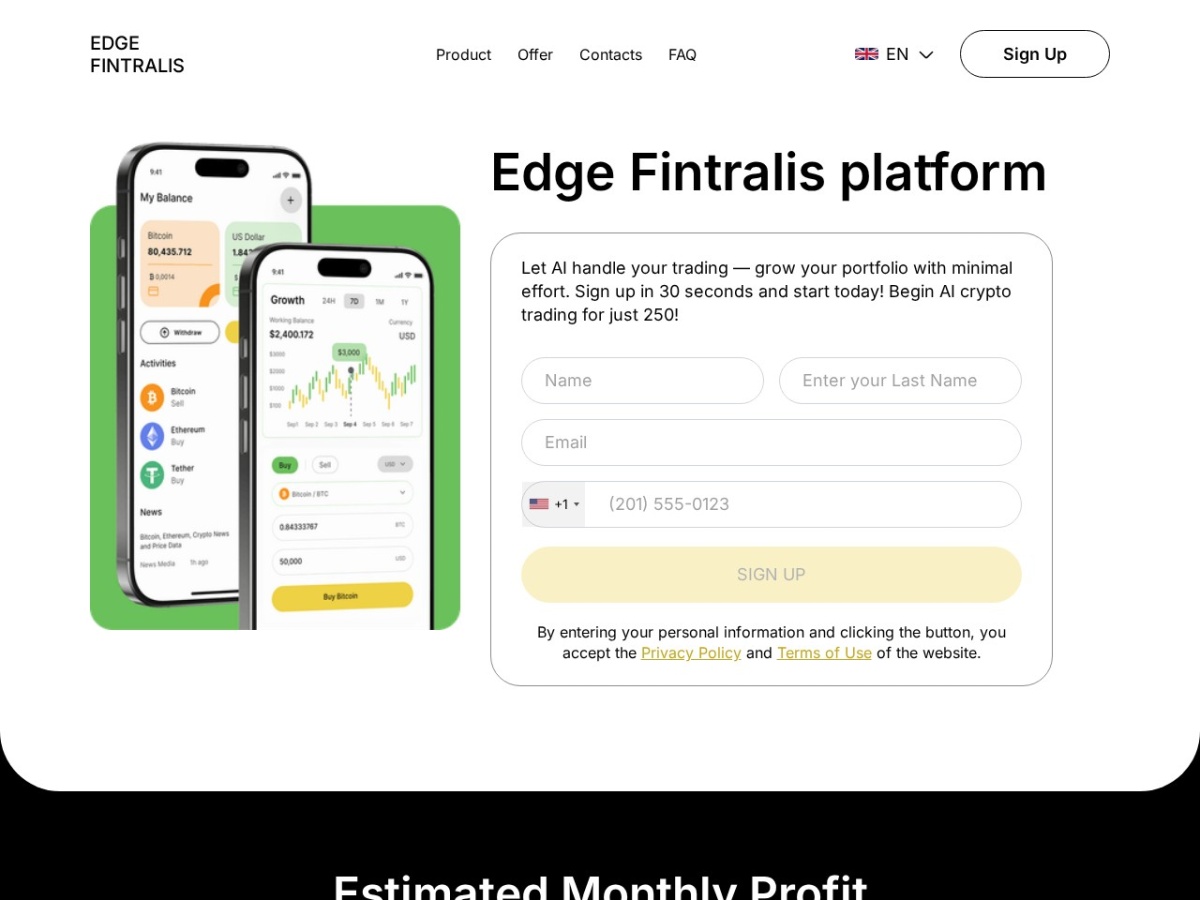
Edge Fintralis positions itself as an AI-powered cryptocurrency trading platform designed to remove emotional decision-making from the investment process. The platform's stated methodology involves monitoring over one hundred market signals per second, analyzing price movements, volume shifts, and momentum indicators to execute trades automatically. Users deposit funds starting from a minimum of 250 units of currency, activate the automated trading mode, and theoretically allow the algorithm to handle market entry and exit points without constant manual oversight.
This is fundamentally different from a traditional exchange like Coinbase or Binance, where users manually place trades. Edge Fintralis functions more like a managed trading service with algorithmic execution—closer in spirit to robo-advisors in traditional finance, but applied to the significantly more volatile cryptocurrency markets. The platform claims compatibility with major credit cards, bank transfers, and PayPal for deposits, alongside cryptocurrency funding options. Withdrawals are advertised as unrestricted in timing and frequency, processed through the same verified payment providers used for deposits.
The interface reportedly supports multiple asset classes beyond cryptocurrency, including forex, commodities, precious metals, contracts for difference, and equities. This breadth suggests the underlying infrastructure may be white-labeled or built atop existing brokerage technology rather than developed entirely in-house—a common practice in the online trading industry that isn't inherently problematic but does raise questions about platform differentiation.
The Security Framework: More Robust Than Many Competitors
One of the more credible aspects of Edge Fintralis, at least on paper, is its security architecture. The platform claims that ninety-eight percent of user assets are held in cold storage—meaning offline wallets inaccessible via internet connection and therefore immune to remote hacking attempts. This is a standard best practice among serious cryptocurrency custodians and represents a significant improvement over platforms that keep the majority of funds in hot wallets for liquidity convenience.
Data encryption uses 256-bit TLS with the latest TLS 1.3 protocol, which is industry-standard for secure communications. Two-factor authentication is mandatory rather than optional, adding a secondary verification layer beyond password entry. Login and transaction notifications are sent in real time, allowing users to detect unauthorized access attempts quickly. Passwords are stored using one-way encryption—hashed rather than reversible—meaning even platform administrators theoretically cannot retrieve plaintext credentials.
Payment processing is routed exclusively through certified third-party providers, and the platform states explicitly that card details are never stored on Edge Fintralis servers. This offloads a significant portion of financial liability and reduces the attack surface for payment fraud. Compared to platforms that handle payment data in-house or rely on unverified processors, this approach demonstrates a reasonable understanding of modern financial security requirements.
However, security claims must be weighed against independent verification. While the described measures are technically sound, users have no external audit reports or third-party security certifications to review. The platform mentions partnerships with entities like Deloitte, CoinDesk, Nansen, and Decrypt, but the nature of these relationships isn't clarified—whether they involve formal audits, media coverage, data feeds, or simple affiliate arrangements makes a substantial difference in credibility.
The AI Trading Engine: Legitimate Technology, Realistic Expectations
Algorithmic trading in cryptocurrency markets is neither new nor inherently fraudulent. Quantitative funds, hedge funds, and proprietary trading firms have used automated systems for years to capitalize on market inefficiencies, arbitrage opportunities, and momentum patterns. The question isn't whether AI-driven trading can work—it demonstrably can—but whether Edge Fintralis has built or licensed a system sophisticated enough to deliver consistent results in retail accounts with relatively small capital bases.
The platform claims an eighty-five percent accuracy rate, which requires careful interpretation. Accuracy doesn't equal profitability. A system could be accurate in predicting short-term price direction but still lose money if winning trades are small and losing trades are large. Without detailed performance metrics—average win size, maximum drawdown, Sharpe ratio, or other risk-adjusted return measures—this figure offers limited practical information.
User testimonials on the platform report returns ranging from roughly eighteen percent to thirty-two percent over unspecified timeframes. These are presented as individual results with appropriate disclaimers that past performance doesn't guarantee future outcomes. In highly volatile cryptocurrency markets, such returns are plausible during favorable conditions but can reverse dramatically during bear markets or periods of extreme volatility. The platform doesn't publish aggregated performance data across all users, which would provide a more reliable picture of typical outcomes.
The emotional and time-saving benefits of automation are real. Manual trading demands constant attention, produces decision fatigue, and frequently triggers emotional responses—fear during downturns, greed during rallies—that lead to poor timing. An algorithm immune to these psychological pressures can maintain discipline that human traders struggle to sustain. This is perhaps the most honest value proposition Edge Fintralis offers: not guaranteed profits, but consistent execution of a predefined strategy without emotional interference.
Fee Structure: Transparent, But Not Necessarily Cheap
Edge Fintralis advertises no subscription fees, no registration costs, and no hidden charges. This is accurate in the narrow sense—there's no monthly platform fee or account maintenance cost. However, all trading platforms generate revenue somehow, and the most common model in this sector involves spreads, commissions on executed trades, or revenue sharing with underlying liquidity providers.
The platform doesn't publish a detailed fee schedule for trade execution, which means users likely discover the cost structure through the spread between buy and sell prices or through commissions deducted per transaction. This lack of upfront disclosure isn't unusual in retail trading platforms but does fall short of full transparency. Serious traders should request explicit fee breakdowns before depositing significant capital.
The minimum deposit requirement of 250 units is relatively low compared to some managed trading services but higher than simple exchange accounts where users can start with any amount. This threshold serves multiple purposes: it filters out uncommitted users, ensures sufficient capital for meaningful algorithmic position sizing, and generates a baseline revenue opportunity for the platform. The promotional language suggesting this represents a seventy-five percent discount from a standard 1,000 minimum is classic marketing framing—there's no way to verify what the "normal" minimum ever was or whether it genuinely existed.
User Experience and Support: The Devil in the Daily Details
Platform usability often determines whether sophisticated technology actually gets used effectively. Edge Fintralis claims an intuitive interface suitable for beginners and experienced traders alike, with options to switch between fully automated mode and manual control. The multi-device compatibility is standard for modern platforms—users expect seamless access across desktop, tablet, and mobile without functionality loss.
The availability of twenty-four-seven customer support is notable, though the quality and responsiveness of that support can only be assessed through actual use. Many platforms advertise round-the-clock assistance but deliver slow response times or outsourced support teams with limited technical knowledge. User reviews mentioning "excellent broker support" suggest at least some users have had positive interactions, though the small sample size and potential for selective publication limit the reliability of these testimonials.
Educational resources are mentioned but not detailed extensively. For a platform claiming to serve beginners, the depth and quality of learning materials matter significantly. If Edge Fintralis provides only basic tutorials and glossaries, it's less valuable than platforms offering comprehensive courses on market analysis, risk management, and strategy development. The presence of educational content is encouraging; its substance remains unclear without direct examination.
The Regulatory Gray Zone: Where Edge Fintralis Operates
Cryptocurrency trading platforms exist in a complex regulatory landscape that varies dramatically by jurisdiction. Edge Fintralis doesn't prominently display regulatory licensing information on its promotional materials, which raises questions about oversight and user recourse in case of disputes. Legitimate platforms typically hold licenses from financial regulators in their operating jurisdictions—entities like the UK's Financial Conduct Authority, Cyprus Securities and Exchange Commission, or Australia's Securities and Investments Commission.
Operating without clear regulatory oversight isn't automatically a sign of fraud, but it does mean users have fewer institutional protections. If the platform fails, gets hacked, or engages in unfair practices, affected users may have limited legal recourse compared to customers of regulated brokers who can appeal to ombudsman services or investor compensation schemes.
The platform's claim of processing over one billion in trades and serving more than four million traders positions it as a substantial operation, though these figures can't be independently verified. Trading volume can be inflated through wash trading or counted cumulatively over many years, and user counts often include inactive or duplicate accounts. Without transparent reporting or third-party verification, these metrics should be viewed as marketing claims rather than validated facts.
The Verdict: Legitimate Platform, But Not a Magic Solution
Edge Fintralis exhibits several characteristics of a legitimate trading platform: reasonable security measures, transparent acknowledgment of trading risks, absence of wildly unrealistic profit promises, and a coherent operational model. The technology described—automated algorithmic trading based on multi-signal analysis—is genuine and used successfully by institutional traders. The platform doesn't promise overnight wealth or guaranteed returns, which distinguishes it from obvious scam operations that prey on desperation and financial illiteracy.
However, legitimacy doesn't equal suitability for all users or freedom from risk. Cryptocurrency markets remain extraordinarily volatile, capable of producing double-digit percentage swings in hours. No algorithm, regardless of sophistication, can eliminate market risk or consistently predict price movements with perfect accuracy. The eighty-five percent accuracy claim, while possibly true under specific measurement criteria, doesn't guarantee profitable outcomes after accounting for trade sizing, risk management, and fee impact.
The lack of detailed regulatory information, absence of independent performance audits, and limited transparency around fee structures represent meaningful concerns. Potential users should approach Edge Fintralis as they would any financial service operating in a developing regulatory environment: with appropriate skepticism, limited initial capital exposure, and continuous monitoring of account activity and platform behavior.
For individuals genuinely interested in algorithmic cryptocurrency trading who understand and accept the inherent risks, Edge Fintralis appears to offer a functional platform with reasonable security practices. For those seeking guaranteed returns, passive income without risk, or a solution to financial difficulties, this platform—like all trading services—will likely disappoint. The technology can assist disciplined trading; it cannot replace fundamental market understanding or prudent risk management.
The factual information and operational details presented in this analysis were provided by Edge Fintralis and sourced from https://edge-fintralis.sbs/, which served as the primary reference for the platform's features, security protocols, fee structure, and service claims.