
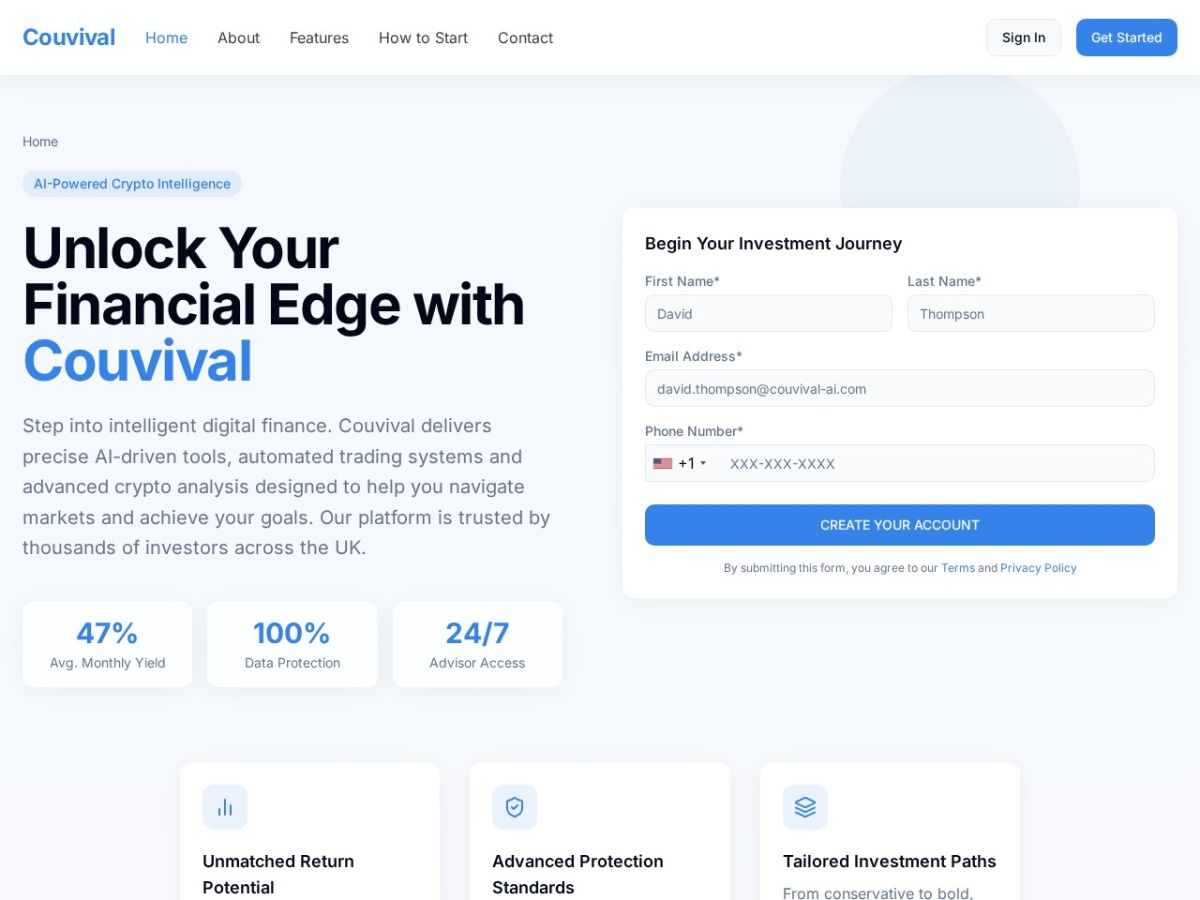
When a platform promises monthly returns of up to 47 percent, the first instinct of any seasoned investor should be skepticism. In the crowded and often murky world of online trading and crypto investment platforms, Couvival presents itself as a cutting-edge solution powered by artificial intelligence, complete with sleek design, reassuring testimonials, and bold performance claims. But beneath the surface of polished marketing, does the platform hold up to scrutiny, or does it raise red flags that warrant caution?
This review takes an independent look at Couvival, examining its claims, business model, transparency practices, and the broader context of similar platforms that have come and gone. The goal is not to dismiss or endorse outright, but to provide a clear-eyed assessment based on available information and industry standards.
What Couvival Claims to Offer
Couvival positions itself as an AI-driven investment platform specializing in cryptocurrency and diversified asset portfolios. It markets a range of features that sound appealing on paper: automated trading tools, access to over six hundred asset types, enterprise-grade security infrastructure, and round-the-clock customer support. The platform boasts a user base of over twelve thousand investors, reports managing more than two billion pounds in total assets, and claims a client satisfaction rate of ninety-eight percent.
The headline figure, however, is the advertised average monthly return of forty-seven percent. For context, traditional equity markets historically deliver annualized returns averaging seven to ten percent. Even the most aggressive hedge funds rarely sustain monthly gains approaching those claimed by Couvival. The platform suggests that this performance is achieved through precision-driven AI strategies and diversified portfolio management, though specifics on the algorithms or risk models employed remain vague.
Couvival also emphasizes accessibility, with a minimum investment threshold of one hundred ninety pounds and a promise of no hidden fees beyond a flat annual management charge of zero point seven five percent. Withdrawals are said to be processed within one to three business days, with expedited same-day options available to premium users. The platform offers a demo mode for new users, which is a positive feature that allows prospective investors to familiarize themselves with the interface before committing real capital.
The Red Flags That Cannot Be Ignored
Despite the professional veneer, several aspects of Couvival's presentation trigger alarm bells commonly associated with high-risk or potentially fraudulent investment schemes. The most glaring issue is the promised return rate. Monthly gains of forty-seven percent compound to an annualized return exceeding fifteen thousand percent under ideal conditions. No legitimate, regulated investment product can credibly sustain such performance without either extreme leverage, enormous risk, or outright fabrication.
Historically, platforms that guarantee or even suggest such returns have often been revealed as Ponzi schemes, where early investors are paid using the deposits of newer participants rather than genuine market gains. This structure can create the illusion of success for a time, but invariably collapses when the influx of new capital slows. The lack of detailed explanation about how these returns are generated, what underlying assets are being traded, or what risk management protocols are in place is deeply concerning.
Another troubling element is the lack of verifiable regulatory credentials. Couvival does not clearly state which financial authority, if any, oversees its operations. In the United Kingdom, legitimate investment platforms are typically regulated by the Financial Conduct Authority, and firms are required to hold specific permissions and maintain client money protections. The absence of such disclosures on Couvival's promotional material suggests either that the platform operates outside regulated frameworks or that it deliberately avoids transparency on this front.
The testimonials and performance metrics presented on the website are also suspiciously generic. There are no independently verifiable case studies, no audited performance reports, and no third-party reviews from credible financial news outlets or watchdog organizations. The claimed client base of over twelve thousand investors and total managed assets exceeding two billion pounds are impossible to verify without access to corporate filings or regulatory disclosures, neither of which appear to be readily available.
Business Model and Fee Structure Under the Microscope
Couvival claims to operate on a transparent fee model, charging just zero point seven five percent annually on managed assets, with no fees on deposits or standard withdrawals. On the surface, this appears competitive compared to traditional wealth management services, which often charge one to two percent or more. However, the transparency claim is undermined by the absence of detailed terms and conditions, audited financial statements, or clear explanations of how the platform actually makes money.
If Couvival is genuinely generating forty-seven percent monthly returns through trading, the platform itself would be accumulating extraordinary wealth at a rate that would make it one of the most profitable financial entities in history. The fact that such a firm is not widely known, celebrated in financial media, or subject to intense regulatory and investor scrutiny is itself suspicious. Legitimate high-performing funds attract institutional capital, academic analysis, and media coverage. Couvival has none of these markers.
There is also the question of how user funds are held and protected. The platform mentions enterprise-grade encryption and intelligent firewalls, which are cybersecurity measures, not financial safeguards. What matters more is whether client funds are segregated, held in trust, insured, or protected under investor compensation schemes. The site references extensive insurance coverage but provides no specifics on the insurer, coverage limits, or terms. This vagueness is a hallmark of platforms that prioritize marketing polish over operational legitimacy.
Security Claims and What They Actually Mean
Couvival emphasizes its security infrastructure, describing it as inspired by enterprise-level technologies and incorporating multi-factor authentication and encryption. While these are standard features of any modern digital platform, they do not in themselves guarantee the safety of investor capital. Encryption protects data in transit and at rest, but it does nothing to prevent mismanagement, fraud, or the platform simply disappearing with user funds.
The real test of security in financial services is not technological but institutional. Are there independent audits? Is there a transparent record of how client money is managed? Are there legal structures in place that protect investors in the event of insolvency or misconduct? Couvival provides no evidence of any of these safeguards. The absence of regulatory oversight means that investors have little recourse if something goes wrong.
Moreover, the platform's promise of same-day withdrawals for premium users raises questions about liquidity. If funds are genuinely invested in diversified portfolios across equities, crypto, real estate, and alternative assets, instant liquidity would be difficult to maintain without either holding significant reserves in cash or employing leverage. Either scenario introduces risk that is not openly discussed.
The Broader Context of Similar Platforms
Couvival is far from the first platform to promise extraordinary returns through automated trading and AI-driven strategies. Over the past decade, numerous such platforms have launched, gained traction, and subsequently collapsed, leaving investors with devastating losses. Names like BitConnect, Mirror Trading International, and various high-yield crypto schemes have all followed similar patterns: aggressive marketing, vague operational details, unsustainable return promises, and eventual regulatory action or outright vanishing.
The crypto and fintech sectors are particularly vulnerable to such schemes because they attract both genuine innovation and opportunistic fraud. The combination of technological complexity, regulatory grey zones, and public fascination with rapid wealth creation creates fertile ground for scams. Investors, especially those new to digital assets, can be dazzled by jargon, slick interfaces, and fabricated performance metrics.
Regulators around the world have issued repeated warnings about platforms that promise guaranteed high returns, urge rapid deposits, or lack clear licensing. The Financial Conduct Authority in the UK, the Securities and Exchange Commission in the United States, and similar bodies elsewhere have all highlighted the risks of unregulated investment platforms, particularly those involving cryptocurrency.
What Independent Investors Should Consider
For anyone considering Couvival, the most prudent course of action is to demand evidence. Before depositing a single pound, potential users should seek out regulatory registration details, verify the legal entity behind the platform, request audited financial statements, and consult independent financial advisors who have no affiliation with the company. If Couvival is unable or unwilling to provide this information, that alone should be disqualifying.
It is also worth remembering the fundamental principle of investing: if something sounds too good to be true, it almost certainly is. No legitimate investment vehicle can consistently deliver returns of forty-seven percent per month without taking on risks so extreme that they would be unacceptable to most rational investors. Even in the volatile world of cryptocurrency, such performance is implausible over any sustained period.
Investors should also be wary of pressure tactics. Platforms that urge immediate deposits, create artificial urgency, or discourage due diligence are employing classic manipulation techniques. Legitimate financial services providers welcome scrutiny and are transparent about risks, fees, and regulatory status.
Final Verdict
Based on the available evidence, Couvival exhibits numerous characteristics commonly associated with high-risk or potentially fraudulent investment schemes. The absence of verifiable regulatory oversight, the implausible return promises, the lack of transparent operational details, and the generic, unverifiable marketing claims all combine to paint a picture that should concern any informed investor.
While it is theoretically possible that Couvival is a legitimate, albeit unconventional, platform operating in a niche space, the burden of proof lies with the company to demonstrate its credibility. Until such proof is forthcoming in the form of regulatory registration, independent audits, and transparent risk disclosures, the platform cannot be recommended.
For those who have already invested, it is advisable to attempt withdrawal of funds immediately and to monitor accounts closely for any signs of difficulty in accessing capital. If withdrawal requests are delayed, denied, or met with demands for additional payments, these are strong indicators of a scam.
In the end, protecting your capital requires skepticism, diligence, and a willingness to walk away from opportunities that promise the moon but offer little in the way of substance. Couvival, as it currently presents itself, falls squarely into the category of platforms that warrant extreme caution. Until proven otherwise, the safer assumption is that the risks far outweigh any potential rewards.