
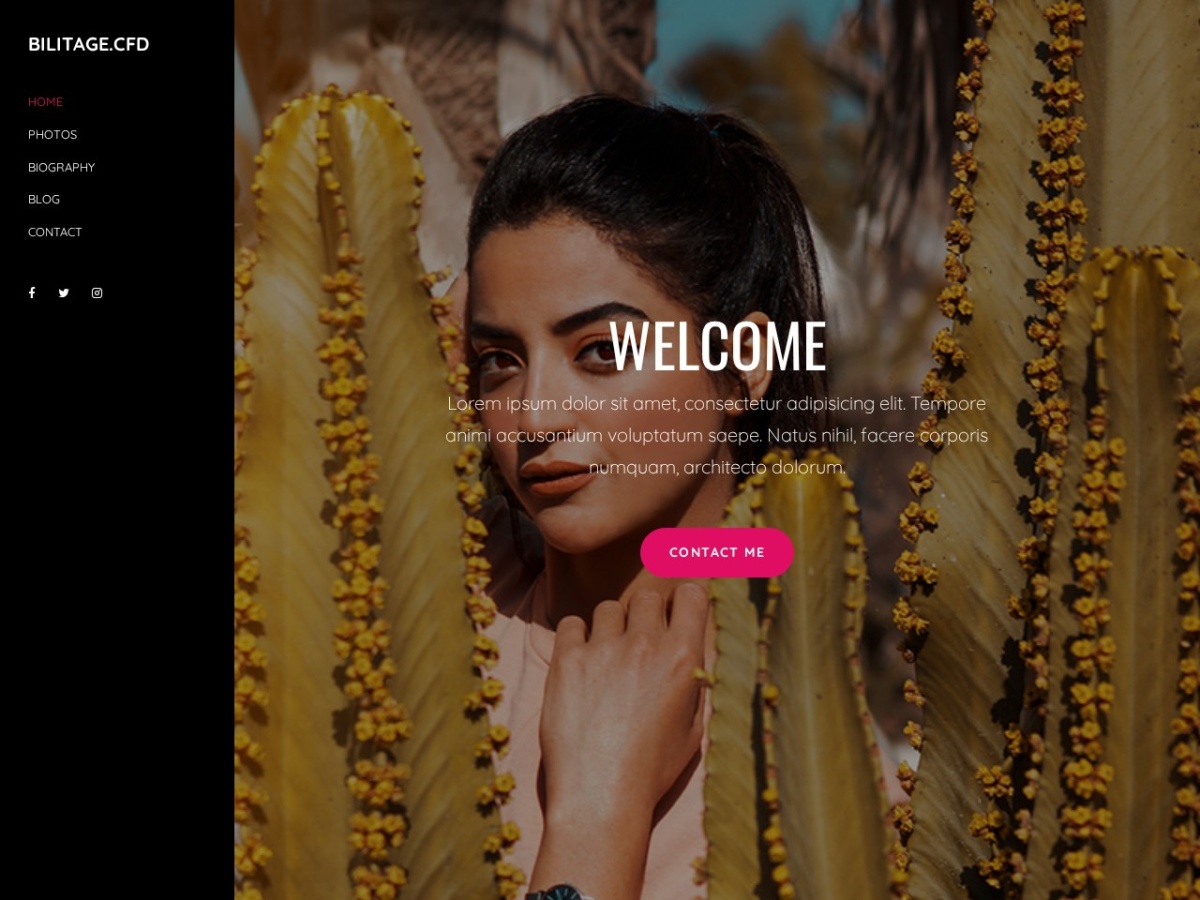
Walking into the digital storefront of Bilitage feels less like encountering a professional service and more like stumbling into an abandoned website template that someone forgot to finish. The moment you land on the homepage, you're greeted not with a compelling value proposition or clear service offering, but with placeholder Latin text—the infamous "Lorem ipsum dolor sit amet" that web designers use when they haven't bothered to write actual content yet. This isn't a minor oversight tucked away in a footer somewhere. This is the entire experience.
For anyone unfamiliar with web development, Lorem ipsum is dummy text, essentially gibberish dressed up to look like readable content while designers finalize layouts. Finding it on a live commercial website is akin to walking into a supposedly open restaurant and finding construction scaffolding still in the dining room, with painters touching up the walls while you're expected to order dinner. It signals one of two things: either the site launched prematurely, or whoever runs it simply doesn't care enough to replace template content with real information.
What Bilitage Claims to Be
The branding, such as it is, positions Bilitage around photography. There's a biography section introducing someone named Jed, allegedly a photographer with ten years of experience. The testimonials section features praise from a "Jean Smith," though both testimonials use identical placeholder text and offer no specific details about what service was actually rendered or why it was valuable. The blog section advertises posts with titles like "My New Photography Has Been Featured in Forbes," all attributed to a "Ben Jones" and all dated January 18, 2019. Each post, predictably, contains the same Lorem ipsum placeholder rather than actual articles.
What exactly Bilitage offers remains genuinely unclear. Is it a portfolio site for a photographer named Jed? Is it a photography blog run by Ben Jones? Are these different people, or are the names themselves placeholders that were never updated? The site provides no services, no pricing, no portfolio of actual work, no client case studies, and no verifiable information about the business or individuals behind it.
The Red Flags Keep Coming
Beyond the placeholder content, several elements raise immediate concerns. The domain extension itself, dot-CFD, is relatively uncommon for legitimate businesses. CFD stands for "Contract for Difference," a financial derivative instrument, and the extension is often marketed toward financial trading websites. Why a photography portfolio or service would choose this particular domain extension instead of the standard dot-com, dot-net, or a country-specific extension is anyone's guess, though it does align with a pattern seen in sites that prioritize cheap registration over professional presentation.
The testimonials deserve special scrutiny. Both allegedly come from Jean Smith and use identical text, which is itself a placeholder. No legitimate business would publish testimonials that are obviously fake template content. Real testimonials include specific details, describe actual experiences, and vary in tone and length because they come from different human beings with different perspectives. Cookie-cutter praise using dummy text doesn't just fail to build trust, it actively destroys it by signaling that the site operators either don't have real clients or don't respect their audience enough to provide genuine social proof.
The blog entries present another puzzle. All four visible posts share the same headline about being featured in Forbes, all carry the same date from over five years ago, and all remain unpopulated with actual content. Forbes is a real publication with a searchable archive. If Bilitage or its photographer had genuinely been featured there, you would expect at least a link to the article, a screenshot, or some substantiating detail. Instead, we get repeated placeholder headlines that read more like aspirational fiction than documented achievement.
The Contact Form and What It Reveals
The site does include a contact form with fields for first name, last name, email, subject, and message. On the surface, this might seem like a functional element suggesting legitimate business operations. In practice, however, contact forms on suspicious websites serve multiple purposes, not all of them benign. Submitting your email address and personal information through such a form could result in your details being harvested for spam lists, phishing attempts, or sold to third parties. Without a clear privacy policy, terms of service, or any verifiable information about who operates the site and how they handle data, filling out this form carries risk with no corresponding benefit.
Legitimate businesses understand that contact forms are trust exercises. They pair them with reassurances: privacy policies that explain data handling, alternative contact methods like phone numbers or physical addresses, and often an immediate auto-response confirming receipt of your message. Bilitage offers none of this context, just an isolated form floating in a sea of placeholder text.
The Absence of Substance
What makes Bilitage particularly troubling is not just what it gets wrong, but what it fails to provide at all. There is no portfolio of photography work, no examples of past projects, no client list, no pricing structure, no description of services, no information about booking or consultations, no credentials or certifications, no links to social media profiles where you might verify the existence and work of the photographer, and no physical location or business registration details.
Professional photographers, even freelancers just starting out, understand that their work is their calling card. They showcase their best images prominently, organize them by category or project type, and provide context about their creative approach. They maintain active Instagram accounts, post on photography forums, perhaps contribute to stock photo libraries, or display badges from professional associations. Bilitage has none of this. It has a vague assertion of ten years of experience backed by precisely zero evidence.
The Verdict on Legitimacy
Can we definitively call Bilitage a scam in the sense of an active fraud operation designed to steal money or identity information? Not quite, because there's no clear mechanism for doing so visible on the site. There are no products to purchase, no subscription to sign up for, no advance payment requested for services. What we can say with confidence is that Bilitage is not a legitimate, functioning business website by any reasonable standard.
It exists in a strange limbo: too incomplete to defraud anyone effectively, yet too deliberately constructed to be a simple accident. The most charitable interpretation is that someone purchased a template, started filling it in, then abandoned the project entirely and left the domain registered and hosted. The less charitable interpretation is that this represents a placeholder for future fraudulent activity, a site being aged to build domain authority before being repurposed for spam, phishing, or other malicious uses.
For anyone considering reaching out to Bilitage for photography services, the advice is straightforward: don't. The absence of actual content, the reliance on placeholder text years after the purported publication dates, and the lack of any verifiable information about the business or its operators make this a non-starter. Even if there were somehow a legitimate photographer trying to operate through this vehicle, the presentation is so unprofessional that it should disqualify them from consideration.
What This Tells Us About Online Scams
Bilitage serves as a useful case study in the ecosystem of questionable websites that populate the internet. Not every suspicious site is a sophisticated phishing operation or ransomware distributor. Many exist in this grey zone of abandonment and incompetence, domains registered with vague commercial intent that never materialized into actual businesses. These sites can still pose risks, primarily through data harvesting if you submit personal information, or simply through wasting your time when you could be dealing with legitimate service providers.
The internet rewards a certain level of healthy skepticism. When a site fails basic credibility checks, when it can't be bothered to replace template content with real information, when it offers no verifiable details about who operates it or what it actually provides, the appropriate response is to close the tab and move on. There are thousands of legitimate photographers with robust portfolios, verified reviews, clear pricing, and professional presentation. None of them are hiding behind Lorem ipsum placeholders and vague claims of Forbes features that can't be substantiated.
In the final analysis, Bilitage isn't so much a scam as a shell, an empty digital storefront that might once have aspired to become something but never took the necessary steps to actually provide value or build trust. Whether through negligence, abandonment, or intentional deception, the result is the same: a website that no reasonable person should engage with for any commercial purpose. The question posed in the title resolves itself not through elaborate investigation but through simple observation. When a business can't be bothered to present itself professionally or provide basic information about its services, it has already failed the legitimacy test before any transaction could even occur.