
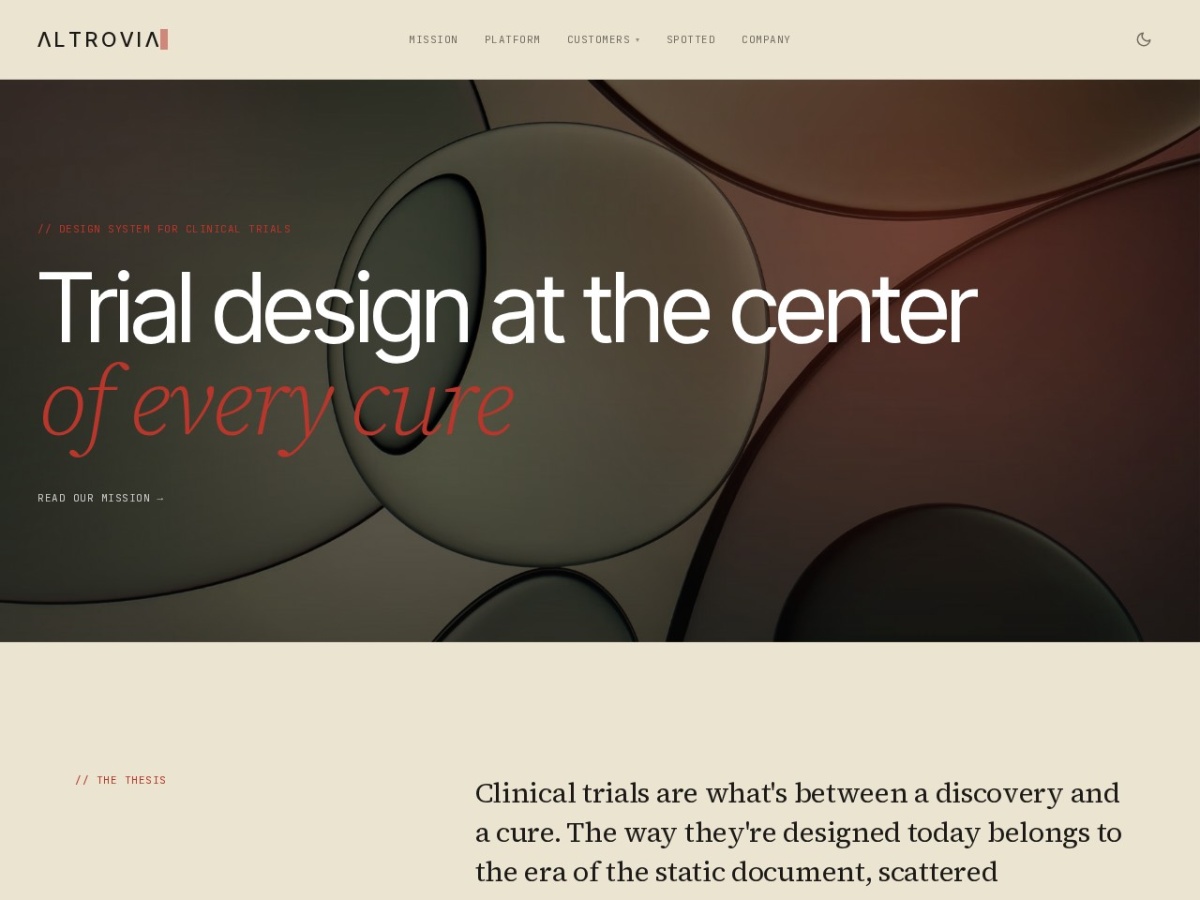
The pharmaceutical industry has a strange relationship with software. Companies that routinely spend hundreds of millions bringing a single molecule to market often run their most critical processes through spreadsheets, email threads, and documents that circulate in a dozen conflicting versions. Clinical trial design, the blueprint that determines whether a drug will prove itself or fail expensively, still happens largely the way it did twenty years ago. Altrevia AI positions itself as the answer to that problem, but the pitch is subtle enough to warrant a closer look.
The Core Thesis: Trials as Systems, Not Documents
Altrevia frames the clinical trial design process not as a static document production exercise but as a living system. That framing matters because it signals a different approach to tooling. Instead of offering document templates or project management dashboards, the company appears to be building infrastructure that treats trial design decisions as interconnected, precedent-informed, and iterative.
The traditional model involves clinical operations teams assembling protocols in Word, reconciling feedback across departments, and hoping institutional knowledge gets captured somewhere retrievable. Decisions about endpoints, enrollment criteria, dosing schedules, and statistical plans scatter across emails and meetings. When the next trial starts, much of that reasoning has to be reconstructed from memory or old files. Altrevia's argument is that this approach belongs to an earlier era, one that predates modern collaboration software and knowledge management systems.
Whether that thesis holds depends on execution, and execution in enterprise software aimed at regulated industries is notoriously difficult. Pharma companies are conservative buyers. Regulatory submissions are high-stakes. Any tool that touches the protocol design process has to integrate with existing workflows, meet compliance standards, and prove itself indispensable before it gets adopted widely. Altrevia is not trying to sell into this market broadly yet. Instead, it is in what the company describes as private deployment with a limited set of organizations. That cautious rollout suggests either prudence or validation challenges, possibly both.
Four Segments, Four Versions
Altrevia has segmented its market into four categories, each with distinct needs and constraints. This is not a one-size-fits-all software-as-a-service play. The company explicitly states that each segment gets a version of the platform shaped to the work they actually do. That customization is either a strength or a scalability problem, depending on how it is implemented.
The first segment is enterprise pharmaceutical sponsors running global portfolios across phase two and phase three trials. These are large organizations with parallel programs in multiple therapeutic areas. The value proposition here is institutional learning: every new program should inherit what the previous ones discovered. In practice, that knowledge transfer rarely happens systematically. Trial designers reinvent wheels, repeat mistakes, and miss optimization opportunities because the learnings from past trials are locked in the heads of a few senior scientists or buried in unstructured documents. If Altrevia can surface precedent and rationale at the moment of decision, that has real value. Whether it does so effectively is hard to assess from the outside.
The second segment is emerging biotechs in phase one and phase two, often designing the single trial that will define the company's future and determine whether the next funding round happens. These teams are small, under-resourced, and facing their first regulatory submission. They need submission-ready trial design but lack the infrastructure and institutional memory of a large sponsor. Altrevia's pitch here is about making sponsor-grade thinking accessible to teams that do not have a full clinical operations department. That is a reasonable positioning, though it raises questions about pricing and how much hand-holding is built into the software versus sold as services.
The third segment is contract research organizations, the service providers that design and execute trials on behalf of sponsors. CROs live and die on the quality of their scientific thinking and their ability to communicate that thinking persuasively to clients. Altrevia positions itself as a tool that makes that expertise visible and defensible, presumably by documenting decision rationale and design trade-offs in a structured, shareable format. CROs are interesting customers because they have deep domain expertise but often lack the software budgets of pharma sponsors. They also work across many sponsors, which could make them valuable distribution partners if the platform proves useful.
The fourth segment is the public sector: academic medical centers, government research bodies, and publicly funded consortia running investigator-initiated trials. These are often high-quality studies operating on shoestring budgets with academic timelines. Altrevia frames the value here as bringing investigator-initiated trials up to sponsor standards. That is a diplomatically worded acknowledgment that academic trials often lag industry in operational rigor, not because of lack of scientific merit but because they lack the infrastructure support that industry trials receive.
What Altrevia Actually Does
The company is notably vague about product specifics. There are no screenshots, no feature lists, no demo videos. The website reads more like a thesis document than a product marketing page. That could be deliberate positioning, an attempt to avoid being pigeonholed as just another software tool. It could also reflect a product that is still being shaped by early customers in private deployment.
What we can infer is that Altrevia provides some form of structured environment for capturing trial design decisions, their rationale, and their dependencies. It likely integrates some form of precedent database, allowing teams to see how similar decisions were made in past trials. It probably includes workflow and collaboration features, given the emphasis on moving beyond scattered documents and email threads. And it appears to generate or support the generation of submission-ready documentation, at least for the biotech segment.
The reference to clinical trials being between discovery and cure is not just rhetoric. Trial design is genuinely the bottleneck. A poorly designed trial wastes years and hundreds of millions of dollars. An optimally designed trial gets a drug to patients faster and with better evidence. The difference between those two outcomes often comes down to a handful of design decisions: the choice of endpoints, the enrollment criteria, the statistical analysis plan, the adaptive design features. If Altrevia provides a better environment for making and documenting those decisions, that is meaningful. If it is mostly a documentation layer on top of the same old process, it is less compelling.
The Legitimacy Question: Scam or Substance?
Is Altrevia AI a scam? Almost certainly not in the fraudulent sense. The company has a coherent thesis, a defined market segmentation, and claims private deployment with real organizations. It is not making wildly implausible promises or operating behind anonymity. The branding is understated, the messaging is sophisticated, and the positioning suggests people who understand the domain.
Is it legitimate in the sense of delivering meaningful value? That is harder to assess externally. Private deployment with a small set of organizations could mean successful early traction with design partners who see real utility. It could also mean a product still searching for product-market fit, with customers who are testing but not yet fully committed. The lack of public case studies, testimonials, or concrete product details makes it difficult to evaluate effectiveness.
The emphasis on customization for each segment is both encouraging and concerning. Encouraging because it suggests responsiveness to real customer needs rather than trying to force-fit a generic tool. Concerning because deeply customized software is expensive to build, maintain, and scale. Enterprise software gravitas often requires turning early custom deployments into a scalable platform, and that transition is where many promising products stumble.
The sector itself is real and underserved. Clinical trial design is genuinely still stuck in document-centric workflows. Tools like Medidata, Veeva, and others have digitized trial execution and data capture, but trial design tooling lags behind. There is room for a system that treats design as a collaborative, iterative, knowledge-building process rather than a document assembly task. Whether Altrevia has built that system, and whether it can scale it beyond private deployments, remains to be seen.
The Market Context
Clinical development software is a fragmented market with high switching costs and long sales cycles. Companies that succeed tend to either offer something genuinely transformative that justifies the pain of adoption, or they get acquired by one of the larger clinical trial technology platforms and integrated into a suite. Altrevia's approach suggests ambitions toward the former, but the private deployment model and limited public presence could also be prelude to an acquisition strategy.
The mention of a design system for clinical trials is borrowed language from software engineering, where design systems provide shared components and guidelines that ensure consistency across products. Applying that metaphor to trial design implies reusable modules, standardized decision frameworks, and institutional memory encoded into the system. If executed well, that could genuinely shift how trials are designed. If executed poorly, it could impose rigidity where flexibility is needed.
The fact that Altrevia targets sponsors, biotechs, CROs, and public sector organizations with differentiated offerings suggests either a very well-capitalized team able to support multiple product lines, or a platform flexible enough to accommodate different workflows without extensive rework. Both scenarios are plausible but difficult to sustain in the long term without either significant revenue or significant funding.
The Bottom Line
Altrevia AI is not a scam in any meaningful sense of the word. It is a real company addressing a real problem in a sector that genuinely needs better tools. The clinical trial design process is outdated, and the consequences of poor design are measured in years and hundreds of millions of dollars. A system that captures institutional knowledge, surfaces precedent, and structures decision-making could deliver substantial value.
The question is not whether the problem is real, but whether Altrevia has built a solution that organizations will adopt, pay for, and continue using once the initial deployment novelty wears off. The private deployment model suggests the company is still in validation mode, working closely with early customers to refine the product before broader release. That is a prudent approach in a risk-averse market, but it also means that much of the value proposition remains unproven in public.
For potential customers, the decision to engage likely depends on risk tolerance and readiness to work with an early-stage vendor. Large pharma sponsors with appetite for innovation and resources to support pilot programs might find value in shaping a tool to their needs. Emerging biotechs betting their futures on a single trial might prefer more established vendors with proven track records. CROs and public sector organizations likely need to see clearer evidence of return on investment before committing.
For observers trying to assess legitimacy, Altrevia sits in the category of serious enterprise software plays with credible positioning but limited public validation. It is not vaporware, but it is also not yet proven at scale. The thesis is sound, the market need is real, and the approach is thoughtful. Whether that translates into a successful product and business remains an open question, one that will be answered by customer adoption and retention over the next few years.